Trade, Finance & Industry
Grace Ashdown
Chair of the Sarrum Bank Council
Chair of the Sarrum Bank Council and the most visible Ashdown in the county, regularly mistaken for the head of her house. She is not; she commands the mechanism by which its policy becomes money, and has used it against her own family.
Grace Ashdown presides over the Sarrum Bank Council: eleven banks about a table in a private house, bound by agreements that are enforceable nowhere and kept because a bank that breaks the Council’s rate finds that the other ten will not clear its paper. Ashdown’s bank is the largest of the eleven, but she sits in her own right, not as the house. A younger daughter, she took the bank at thirty-one on her brother’s death; she has been the only woman at the table for eleven years and has held the chair for nine, by a rotation that has ceased to rotate. When a Sarrum credit stoppage needs a face, it is hers.
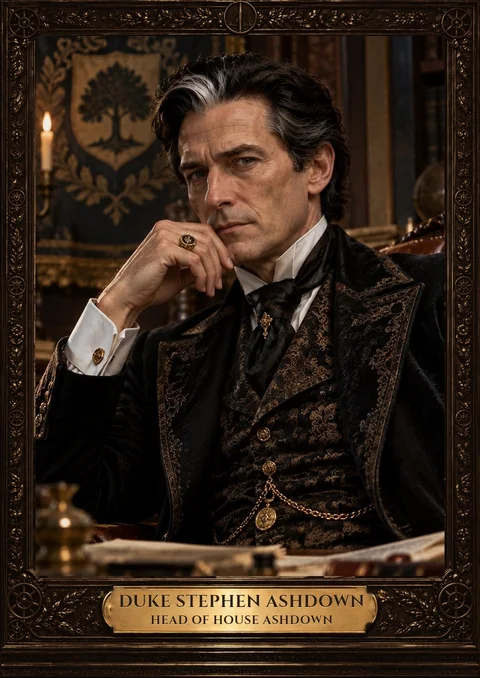
Outsiders routinely take her for the effective head of House Ashdown. The mistake is understandable and constitutionally wrong: Duke Stephen Ashdown holds the Lords seat, the family settlements and the final word on house policy. Grace controls one of the instruments by which that policy acquires force, and twice, both times over whether to call in estate paper in a black year, she has voted the Council against her own family. Both times the house paid. The county holds this admirable or unnatural according to who is speaking; it is also why the associations and the Weavers prefer to deal with her. That an Ashdown should chair a council her family stands behind is a conflict nobody in Sarrum has ever named aloud.
She is known for saying the unsayable thing in the minutes and keeping silence on it ever after. Her remark on provisioning and vulgarity is quoted the length of the belt, the Oxford–Cambridge country of the High South, by people who have no notion it was made at a meeting about grain advances. Cold, some call her, and others correct, in roughly equal numbers; and of all displeasures in the High South hers is the most dreaded and the costliest. Much of her power is nothing more than knowledge. A firm’s bills begin to come in late, and she knows it weak before its own workers do.
The Bank Council does not open its doors in any ordinary sense. It hires through intermediaries, will not put a sensitive commission in writing, and prefers an establishment already used by a hall or a charter company; Grace Ashdown remains the usual channel. Companies meet her, if at all, at one remove: an unwritten commission passed through a third party, and later a quiet word in Fleecegate about how it went. She is the most useful person in the county to a company that needs a door unlocked, and the least advisable one to disappoint.
“My house believes that a campaign is provisioned before it is fought and that somebody must lend the money, and that the men who do the lending are thought vulgar by every man who has ever needed them.”
In person
Grace Ashdown is tall and slender, with rich red hair worn elaborately dressed, a long, controlled and elegant face, dark-green eyes and a pale complexion marked by a small beauty spot beneath one eye. In the least ornamental of the Great Houses she is the conspicuous exception: she loves fine dress and jewellery, and appears in jewel-toned gowns of rich fabric with rings, necklaces, earrings, bracelets, brooches and jewelled ornaments in her hair, the insignia of house and bank worked into the display. The effect is of a woman entirely at ease with being looked at, and entirely aware of what is being counted while she is.
- Affiliation
- House Ashdown / Sarrum Bank Council
- Born
- c. 4579 A.C.
- Age
- about 42 years old in 4621 Years After Cataclysm. The present day is 4621.
- Active
- Chair since c. 4612
- Where
- Sarrum · The Bank Council house, Fleecegate · Sarrum and Its CountySarrum · Ashdown's Bank, Black Stone · Sarrum and Its County
- Calling
- Banker, Nobility
- Appears in
- Book I, Book III, Book IV
- Named with
- Ashdown's Bank, Bank Council, House Ashdown
Named in the books
- Book I · 10. The Great Houses, Councils, Barons, and the Practical Rule of Britannia The Present Heads of the Great Houses · The Principal Spiritual, Military, Naval, and Civic Personages
- Book III · 1. The High South at a Glance Four Houses: Bread, Certification, Horseflesh, and Credit
- Book III · 18. The Four Houses, the Small Nobility, and the Clearance Roll House Ashdown and the Credit of the County
- Book IV · 5. The Halls, the Bank, and the Walls Outside The Bank Council, and How It Actually Works · The Ring Season, Marriages, and the Respectable City
- Book IV · 7. What a Wage Buys, and What It Does Not How a Neighbourhood Is Run
- Book IV · 11. Drink, the Houses, and the Rows Sheets, Rumour, and the News That Moves
- Book IV · 13. What a Sarrum Man Knows, and What a Company Should Employers, Company Chapters, and How They Open
- Book IV · 14. The Coal Country and What Is Under It Ironmere, 4597, and What Was Not Written
- Book IV · 20. The Two Houses and the Line House Ashdown and the Money Half