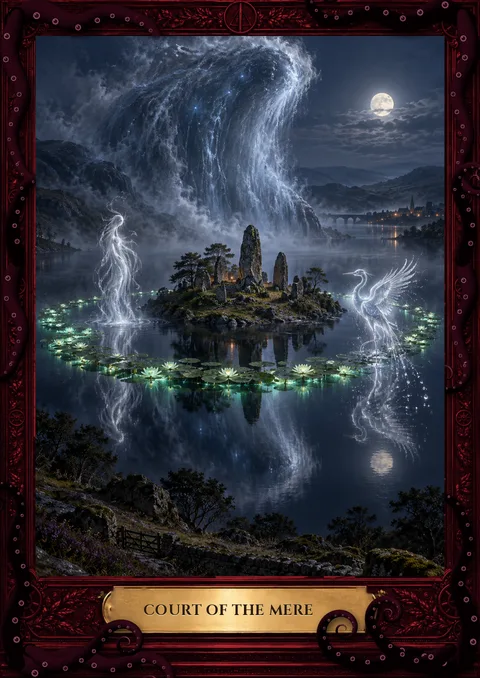
A spirit is a force of nature, and every one is bound to a place. Ford and grove, spring and mere, ridge, and the weather above a single field all answer to a thing more ancient than any title the Crown could draw up, which stood there before the Apocalypse and stands there yet. The dead they are not; the dead they never were. Nor was it an empty country out of which Britannia was won back, for whole districts are fit to dwell in only because someone keeps faith with the terms made with the powers of the place.
“It does not want anything new. That is the first thing to tell a stranger and the last thing he believes. Give it what it had before, at the hour it had it, and it will go on being what it was.”
What a spirit is
A spirit is a power bound to one piece of ground: a ford, a grove, a spring, a ridge, one reach of a river. It is not a god, not one of the dead and not a person, and it is not a demon, because it belongs where it is. Its power is bounded absolutely by its ground: weather over one field, the water in one reach, the luck of one wood. Outside that bound it does nothing whatever.
A thousand years of dispute over the nature of spirits have not altered by a hair the manner of dealing with them. The soundest working account calls a spirit the bond between some piece of ground and every promise ever made to it, a bond that conducts itself as if possessed of a will. Whether anything stands behind it to possess that will is past anyone’s knowing. Into this the law does not inquire. What it acknowledges is the arrangement struck at a place; the spirit it never acknowledges as party to anything.
Where they came from, and why they stayed
No witness has ever professed to see a spirit come. Most folk believe they dwelt in the land from the first, and that the old world merely left off hearing them; that the Apocalypse, breaking that world, let them take back their ancient bounds; and that those who lived through it woke in a country thick with powers that were not human.
No one expelled them after, for no one had the means; a spirit and its place are one, and without the places there was no Reclamation. Their nature, and their title to remain, are in dispute to this day. At Oxford they are held remnants of the fall, squatting on ground to which they can claim no right, and every pact therefore a stopgap, to serve until the Reclamation is complete. At Cambridge they are phenomena, things to observe, to compare, and now and then to put to use. The pact-families think the whole inquiry an impertinence, the arrangement having answered well before anyone thought to question it.
What they want
Ask what a spirit wants and the answer, nearly always, is that things go on: that what it has had from of old should come to it at the old season and after the old fashion. A stone kept white with lime; green boughs laid where a water rises; this field mown before that one; a turn of the lane at which no child will whistle once dusk is down. None of it is superstition worn smooth into custom. It is the bargain itself. Leave the first of the catch upon a stone, let it lie there rotting with no mouth ever touching it, and it will have served its turn regardless. Nor does it profit to give more; a costlier gift is no gift that was agreed, and is useless, and on occasion perilous.
There is fondness between people and the powers that keep them, and it shows in the names they give: the Grey Lady of a mere, the Old Watch of a ridge, the Keeper under a bridge. Yet a friendly power is not a tame one. A river may hold one ford safe and, fifty yards downstream, where nothing was ever promised, drown a man. Temperament, say the villagers. Exactness, say those who work with spirits, and they have the better of it: the power keeps what was promised, where it was promised, and not one yard beyond.
Not the dead, and not a haunt
Spirits belong to the land; they are not what is left over of a person. In the marches the distinction is put in four words: a haunt repeats, a power answers. Whatever the parish does or fails to do, a haunt goes through its one act in its one place at its one season, and there are no terms to be had of it. For a haunt one sends to a suppressing house, or else to the Wardens of the Quiet Ground, a lay body which walks and keeps troubled ground, that they may walk it. A power, by contrast, is moved by what is done. Keep faith with the term, and the ford gives its warning in good time before the water turns bad; neglect it, and the beasts fall thin and the weather over one field goes amiss. With the dead it is a different trade again. A power stood here before us and will stand when we are gone. The dead were ourselves, once, and are set right by the Brethren of the Black Lantern, and nobody bargains with them.
To a stranger the old titles may mislead; to the country that lives under them, never. Such names as the Grey Lady of a mere, the Grey Nun of a meadow, the Old Watch of a ridge or the Keeper under a bridge belong to the water, the ground, the height and the crossing they are given for, and each is the power of that place and nothing besides. Not one of them was ever a woman or a man who died there.
Who speaks for them
Spirit-work is a matter of people and places, and not of offices. Through most of the realm it falls to the pact-families, households that have kept a place’s terms for generations, and to the marsh wives, the ferry speakers and the hedge-readers: those who know what may be promised to a ford or a grove without making the rest of a life impossible. In the High South, the country called the belt, it falls to the Ladies, women who commune with the spirit world more readily than anybody has ever managed to explain. They take their pay in kind, and are sent for before the priest comes and again once he has gone. The northern march has three of its own: the ridge-wise of the wold, who know ground; the wise woman of the fen, who knows water; and the cunning man of the wood. Elsewhere there are shamans and druids besides, and opinion of them divides by district. To some they are keepers of old agreements, readers of weather, renewers of pacts. To others they are men and women who went too far into the patience of a marsh, a wood, a ridge or a storm line, and came back with their loyalties altered.
Whatever authority a spirit-worker has, he holds it through his bond with one place, and the bond is the property of the place rather than of the man. Within it he may renew an arrangement, bear an offering, judge the coming weather by water and beasts, and tell whether a stretch of ground is turning bad and which way it turns. Beyond it, none of this travels with him. Take a marsh wife twenty miles from her own water: her counsel is as sound as ever, but there she has no standing, that is, no right anyone recognises to make terms or to renew them. Across the sea matters stand no differently. In the Black Banner ports, terms are kept by inheritance with the powers of this channel, that reef, the other cove, and the shamans of the far interior are mightiest on their own ground and noticeably less so off it.
How the land was tamed
Force alone never carried the Reclamation forward; bargaining carried it too. In one valley the church bells were accepted on the understanding that the upper ash grove should never feel an axe, and on one river the dredging each spring was suffered provided the ferry songs went on being sung. Certain reclaims live in memory for the very reason that men came second: the spirits had drawn the land back into their own order before ever a settler set foot there again. The Ashfall Reclaim of Saint Merrow’s Fort, 4547, is held up to learners as a warning. The Stillwater Orchard Return, in 4613, tells the other side, three parishes conceding that soil and fruiting had steadied under the spirits’ order before any tenant came back.
Terms are made through the Concord of Saint Winnow or a pact-family, and cost nothing in money, only a promise that outlasts the man who makes it. The Church tolerates courtesy and inherited offering; it condemns worship, the sacrifice of persons, and any claim that a spirit rules above God.
When the terms are forgotten
Pacts are rarely broken. They are forgotten: an old woman dies and nobody takes up what she did every Whitsun. Ground changes when a ford is bridged or a spring piped, and holdings pass to families never told. Consequence arrives on a schedule, first in stock, then in weather over a small area, then in water, then in small accidents that are individually ordinary and collectively not. Someone is sent for only after two or three years.
It is the present holder who pays, and the present holder is very often a buyer who acted in good faith. No pact is renewed save by one with standing, which is to say one whose right to keep the terms for that ground is recognised; and should that standing have been parcelled out among heirs, or have lapsed altogether with the line, then renewal is beyond anyone. Two roads are left. Either a suppressing house is brought in to put the power down, or the Wardens of the Quiet Ground walk the land, year upon year, for exactly so long as someone goes on paying them.
Older than the reckoning
Whatever the law will or will not recognise, those who live beside the powers do not doubt that something is there. A spirit is an entity and not a beast: it has no body to wound and no life to take, and it lasts. The ford's power was old when the first bridge was talked of; the storm over the ridge was old when the ridge had another name. Centuries are nothing to them, and some of the oldest arrangements on the Concord's roll were made with powers that were plainly ancient already.
For a spirit, existence is its own reason. It wants no coin, no praise, no worship and no advantage; none of the things a man is moved by moves it. What it needs is to go on, and everything it does can be read as that need meeting the world. Some answer reason: they can be spoken to, they mark what is said, they keep to what is agreed and can be shown that a new term serves them as well as the old. Others answer nothing, any more than frost does, and the hedge-readers say the first task at any ford is to learn which kind it is.
The node
What a spirit depends on is not the water or the stone but what lies under them. The hedge-readers call it the root, the Collegium the source, the old pact-books the well; the word that has stuck among those who deal with such things is node. A node is the place a spirit draws its existence from, and a spirit lives where its node is. That is why a power of a ford cannot be asked to move to the next ford, and why a spring piped twenty miles away is a spring no longer: what was promised was never the water.
The water and the stone are only how the spirit shows itself there. A spirit on a node under a spring works through the water; the same kind of spirit on a node under a ridge works through the wind and the snow. It cares nothing for either. It needs the node, and everything a district has ever done to keep it content has, knowingly or not, been a way of leaving the node alone.
Asleep, or ruling
Where they came from is the oldest quarrel in the country and the least likely to end. The commonest belief is that they were sleeping, and that the breaking of the old world woke them; hence the stories of a country that went quiet and then, in the ruin years, was full of voices. The fen and the oldest pact-families hold otherwise, that the powers ruled the land before ever man came into it, and that what men call a pact is the powers allowing them room. Scholars at Cambridge argue whether the spirits have always been what they are, or have become it, slowly, out of the ground and what was done on it.
Oxford's answer is doctrine and is given elsewhere: that they are of the fallen orders, holding what they have no right to. None of the answers is ever settled by a spirit. Asked, the ones that answer at all answer about the ford.
What a power can move
A spirit works through what belongs to its place. It can move things there, a gate, a boat, a stone in the stream; it can turn the forces of the place, the water, the wind over one field, the frost in one hollow, the fire on one hearth; and it can lean upon living things bound to the ground: the stock that drink at its water, the deer of its wood, the birds that nest under its bridge. Shepherds know a field where the ewes all stand facing one way before a storm.
People are reached the same way, and only the same way. A traveller passing through is nothing to it. But a man who has farmed the same holding all his life, a widow who will not leave the house where her children died, a family whose dead lie in the one churchyard for three hundred years: these are tied to the place, and the more a person's feeling is fixed there, the more a power of that place can bear upon his dreams, his moods and at last his will. The hedge-readers counsel anybody in grief to walk away from the ground of it for a season. They do not always say why.
Not to be killed
A spirit cannot be killed. Steel passes through what has no body, fire burns what is in the place and not the place's power, and a parish that drives one out has generally only moved it, or made it angry. The realm's methods are therefore all methods of constraint. A power may be trapped: bound into a stone, a vessel or a narrow piece of ground and kept there. It may be captured and carried off, which is what Cambridge's retrieval warrants do. It may be cut off from what sustains it, the spring piped away, the grove felled, the observance it lived by stopped; then it dwindles and is quiet, sometimes for a generation. Or it may be forced into obedience, which is what Oxford means by a capitulation, and what the Black Lantern Brethren mean by a suppression when they break a power that will not treat.
Destruction is possible, but it is rare, costly and particular. The few practices known to work differ from one kind of power to another and even from one power to the next, and most of them were found once, at great price, and not written down. That is why a suppressed district so often comes back angrier: what was put down was usually not ended, only held, and what is held may get loose.
What the spirit hunters kill is something else. A power that takes a shape, a black stag at dusk, a woman among the lilies, a pale wolf on the rock, can have that shape broken, and the creatures that keep its ground can be killed like any beast. That is a spirit hunter's trade, and it is hard enough. The power itself is not touched by it. It is quiet for a while, and then the shape walks again, or the ground finds other keepers; and the hunters are the first to say that the killing was seldom needed in the first place.
Blight in a power
Blight reaches spirits as it reaches fields and herds. A power whose ground goes bad goes bad with it: its wants turn from going on as it was to undoing what is about it. The spring turns sour and then the wells beside it; the wood that turned boar from the lambing begins to send them; the ford that warned now drowns. A blighted power is not a demon, for it still holds its place, and it may be the oldest neighbour a parish has. It is simply sick, and more ready to destroy than to keep.
Whether it can be mended is argued. The Wardens say a power whose ground is mended will mend with it, if it is caught early; the suppressing houses say a blighted power is the commonest reason they are sent for, and that it is cheaper to bind one than to nurse its country back.
In the tamelands
In the settled country most spirits are no danger to anybody and want nothing to do with people at all. They keep their ground and their seasons, and a parish that keeps its few small terms may go three generations without a sign of them. The trouble, nearly always, runs the other way. People want them: for weather and luck, for a cure, for the knowledge a power has of its own ground, for the essence Cambridge buys under a bill of taking, for the thrill of a fashionable evening at a haunted ford. Charm-sellers promise access, gentlemen try terms on their own authority, and a district that was quiet for a century finds its spring disturbed by somebody who wanted something from it.
The pact-families' advice to a company is short. Leave a quiet power alone, and ask who has been bothering it before you ask what it has done.
For a company
Most spirit commissions call for neither blade nor rite. They call for research: the discovering of what was promised, by whom, to what, and of who now holds the standing to keep that promise. Such work is done among the muniment rooms where old deeds and records are laid up, at the firesides of the aged, and over a great many miles of walking. The employer may want a pact defended against some developer, a term pieced together again before the last who keeps it is dead, a rival power identified, or proof that a protective power is no longer what it was. On its own authority a company should promise nothing whatever at a boundary stone; and it should look to find a village insisting upon a dozen observances, of which two alone signify. Destruction of the spirit may well prove the worst course. The band that discovers this only after accepting a warrant from Oxford to destroy one may wake to a whole district ranged against it, courteously, and without a dissenting voice.