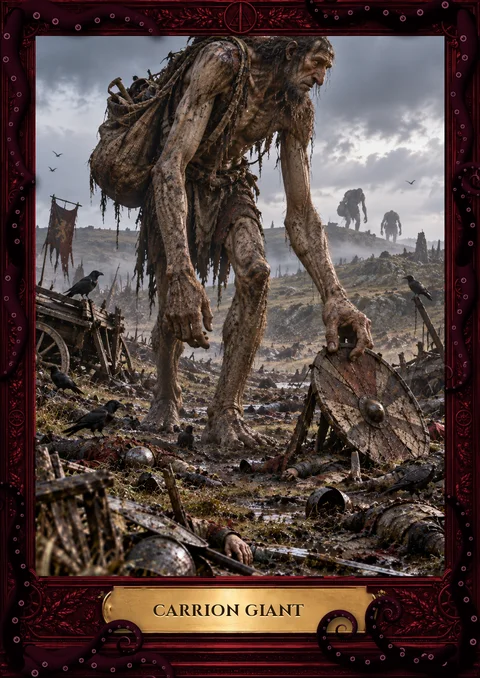
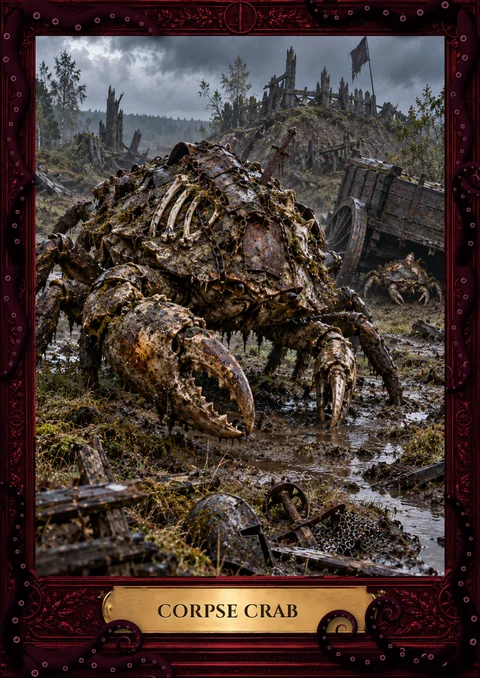
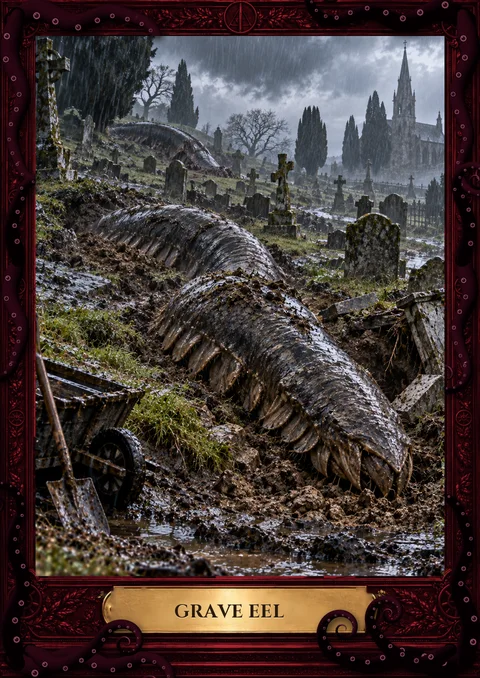
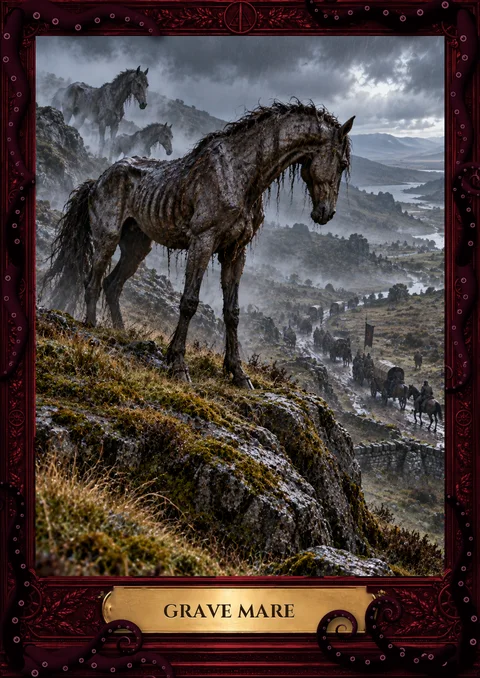
Corpse eaters are not what spoils a ground; they are drawn to ground already spoiled. Clearing them is the commonest supernatural work for hire in all the realm, and the shrewder companies understand it to be half a task and no more.
“Wee calle hem gooles in the bokes and grave-dogges in the feeld, and the name doth nat matere. What matereth is that they were nat ther the yeer before, and thou shalt aske thyself what is newe in thy ground and nat what is newe in thy wode.”
Living things that eat the dead
Ghouls is the manuals’ word; in the country no one uses it. Parishes speak of corpse eaters, of grave dogs, and of a few things unfit to print. On their nature there is no quarrel at all: they are living creatures that feed upon the dead. Dead themselves they are not; people they never were; rise they do not. And since they are living creatures, and neither powers nor the dead, no suppressing house can touch them, which single plain fact governs the realm’s whole dealing with them: they are hunted down and killed, as is any other living thing that is dangerous.
Their origin is a different question. According to the chapter, the governing clergy of the Church, they are blighted things, cursed out of the sins of the apocalyptic age, and that is what a company will be told by whomever it asks. What can be proved amounts to less. They have been about since the ruin generations, and young ones are seen; but no birth of one has ever been recorded, and no corpse of one has ever been found save of one that was killed. Cambridge has twice requested a body for study, and been twice refused, the question being judged improper.
Sized wrongly
Nearly every death they cause comes from a man misjudging them. They stand about the height of a child of eight or nine and are strong out of all proportion to it: a grown man cannot hold one down, and two will have a door off its hinges. Some are near enough human in shape to pass for a child at fifty yards in bad light, which has killed people who went to help. Others are nothing of the kind, and one band will hold both sorts.
They go abroad by night, and dig. Fresh graves are what they seek above all, or earth that is open already; cleverness is not in them. All that they enter they befoul, and every ground they have been in must then be consecrated anew by the chapter, whose books will say so, of that ground, ever after.
Light, and what lies beneath
Hard light is past their bearing. They will creep to the rim of a fire’s glow and think nothing of a tallow candle; but a hard white beam sends them aside, and so does a burning glass, a lens that draws light to one point. Light neither kills them nor holds them for long. It settles their direction, no more; yet in a culvert with one way out, their direction is the whole of the battle. Hence even companies with no intention of entering foul places will lay out two pounds ten for a sealed lamp to last the season.
Out in the parishes one meets a working party, of four or as many as nine. Beneath a city raised over culverts, cellar runs and drowned service ways lies something of another order, and of London’s lower ways there is no account that does not use the word swarm. Upon the Wye scarp in Kent are the corpse eaters called the Chalk Hounds, present since the first Kentish records were kept; there they are no event but a permanent circumstance of life. Where a landing place finds its foreshore graves being lost to them, the county answers with lanterns, a great many, lit from dusk till dawn, it being universally agreed that these creatures will not remain in a lighted place.
For a company
The pay for a clearance is a pound, now and then thirty shillings, and six hands may finish it in two nights, or three. The hazard is genuine but commonplace, the labour honest, and plenty of bands have never undertaken anything else. Yet it is but half a commission. First the ground went wrong; then the corpse eaters came, frequently a whole season ahead of any other token. That is why country priests are schooled to welcome them, as the earliest warning a parish receives and the single symptom it can see, tally and shoot. The company that clears them and departs has its pound honestly earned. The company that lingers to ask what altered in the burial ground the year before is worth four times as much, and will get no thanks for its curiosity.