
Great House · also Bank, finance & insurance
House Ashdown
“Credit before crown”
Also called Ashdown · Hartfell and Ashdown · the Ashdowns · Ashdown cousins
Banners and seals
-
 ★ Main emblem “Credit before crown”
-
 “Still we stand”

The newest and least ornamental of the four Great Houses, whose power is credit: stores, advances and disciplined correspondence exercised through the Council of the Banks rather than land. It began as a provisioning concern that lent to the Crown in the treaty wars and was paid in charters.
The money half of Sarrum's two houses: stores, credit, provisioning and paper. It holds the staple houses, interests in several banks, the largest single holding in the line and about a third of the ring of farms, and finances Crown provisioning contracts. The latest of the belt's four houses to reach great-house rank, holding leverage through stores, advances, warehousing interests and the credit by which the county's movement survives a poor season.
Named with it
- Duke Stephen Ashdown (head
- holds the Lords seat)
- Grace Ashdown (kinswoman
- chair on the Sarrum Bank Council)
- Sir Robert Ashdown
- David Ashdown (bears the house name
- runs the Society for Corrected Antiquities)
- Grace Ashdown (presides over the Bank Council
- constitutionally distinct from the headship of the house)
- Grace Ashdown (sits on the Council of the Banks
- the house's public face in the county)
- Anne Vell
- Grace Ashdown (younger daughter
- heads the Ashdown bank in her own right)
- seat in the Lords)
- commands the bank
- chair of the Bank Council)
- Sir Godfrey Ashdown (cadet
- holds Ashwell)
- Ancel Mortmain
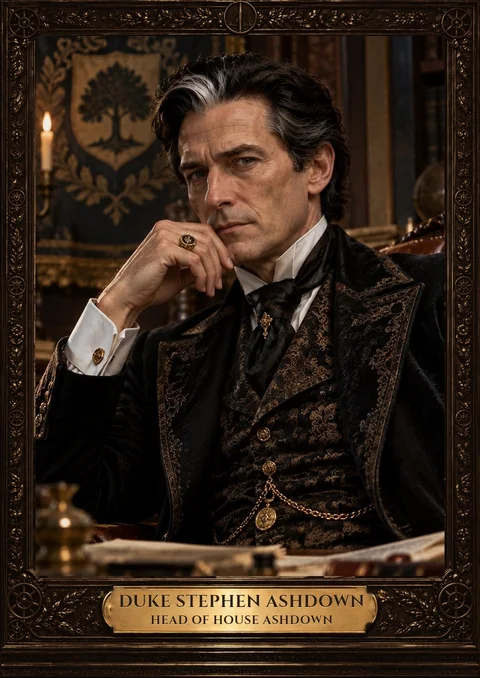
Duke Stephen Ashdown
Head of House Ashdown
Grace Ashdown
Chair of the Sarrum Bank Council
David Ashdown
Society for Corrected Antiquities Grace Ashdown
Chair of the Sarrum Bank Council Grace Ashdown
Chair of the Sarrum Bank Council Grace Ashdown
Chair of the Sarrum Bank CouncilTies
- cold but permanent relationship with House Hartfell
- Grace Ashdown chairs the Bank Council
- one of the four houses of the belt
- linked to the Sarrum Bank Council through Grace Ashdown
- recurrent petitioner in the Collegium's assay courts
- interested party in the Oxford chapter court
- one of the eleven banks of the Council of the Banks
- stands with House Halden, and in commercial matters with Marr and Vane
In the chronicle
At the table
The conservative school lists leave it out of the Great Houses still; Westminster's copies, and the bankers', put it in. Strangers commonly mistake Grace Ashdown for the effective head. The elder Ashdown circles stood by Robert II in the War of the Two Kings. The power to withhold credit is its weapon. Its factors keep no ceremony and turn up wherever a warehouse receipt, an advance or a bond has made them needful. Three counties dislike it, and all three need it. It has no means of making the Bank Council act, and on the two occasions the council called in estate paper it paid. Of the houses it alone has no black story, which is to say no notorious tale fastened to its name; in place of one there stands the foreclosure of 4571. A Crown approach over line rates in 4611 it met with silence. And while the other three houses merely hold their ground, its instrument, credit, grows.
- Kinds
- Great House, Bank, finance & insurance
- Region
- Sarrum and Its County
- Founded
- c. 4300 A.C.
- Standing
- Present day
- Seat and places
- Sarrum County; house near Coldwell; town establishment in Fleecegate; Sarrum
- Named in
- Book I, Book II, Book III, Book IV, Book VI
- Spoken of
- 63 times in the volumes
Where the volumes speak of it
- 1.4 Four Houses: Bread, Certification, Horseflesh, and Credit
- 18.1 House Halden, the Golden Sheaves
- 18.4 House Ashdown and the Credit of the County
- 18.5 Alignment, Rivalry, and the Standing Balance
- 23.9 Soldiers, House Men, and the Crown’s Thin Presence
- 31.10 Visits, Matches, and the Provincial Social Year
