What the country has seen beyond the lamps, drawn as its witnesses describe it
Type · Beast
A beast is an animal, and the word is meant to be plain. The Bear of the fell woods, the Dire Wolf that leads the ordinary packs onto prey they would not take alone, the Swamp Lion at the reed edge and the Marsh Crocodile lying along a cut like a log are all beasts, however large or however bold, and the country takes some comfort in saying so. Under the same badge stand the animals grown wrong: the wolf and the bear the dales call turned, the Mutated Serpent of the carrs, and stock that has gone over, which is the upland’s own phrase and which the upland does not explain.
The fells ask three questions of anything that troubles a flock, and a stranger should learn them before he learns anything else. Does it breed true? Does it keep to its ground? Can it be turned from the lambing? Three yeses, and it is a beast in the shepherd’s sense as well as in its shape, met with dogs, a lit fold and a bounty of two shillings a head; the art is to make one’s own pasture the least rewarding place in the dale, not to win. One no, and the shepherd ceases to treat it as a beast, whatever it looks like. He moves the flock, and waits in seasons rather than weeks.
Type · Monstrosity
A monstrosity has a body, and that is the first thing to be said of it, because it is what divides it from the horrors. It is big, or wrongly made, or both, and it breeds after its kind: the Bell Worm that comes through a coal face with its mouth open, the Hydra of the Oxford marsh, which the causey households tell as though it were last year’s, the Red Drake that comes up out of the wet ground for horses and goes back into it, and the Sea Leviathan that rises beside a ship on the long routes, higher than the mast. Its witnesses differ over what frightened them. In the main they agree on what they saw.
Because it has a body, it can be brought in. A bounty man may carry a head to the bailiff, and the clause at the foot of the Crown’s schedule, such other noxious beasts as the bailiff shall judge, might have been written for it. That is the comfort. The difficulty is that a monstrosity fails the shepherd’s three questions, so that the turning which serves against a wolf serves poorly against it. The country’s answer is ground given and ground kept: the fen keeps its reed cut, no pit opens into ground that is on no plan without an officer present, and the drove goes round. A company is hired where that answer has stopped being enough.
Type · Plant
A plant is a growing thing that does more than grow. Trees walk; the Hangman’s Willow lifts what passes under it, a boar, a calf or a dog, and holds it clear of the flood until it stops moving; the Red Briar closes over an empty cottage and whatever comes to its door; Grasping Vines drag what they hold down into the earth. Most of them pass for ordinary growth until they move. The country’s first warning is seldom the plant itself. It is the wrong thing lying at the foot of a tree: bones, a dead deer, salvage that nobody has taken.
They keep to their ground. A plant does not follow a company down the road, and nearly every account of one ends with somebody who went round. Some are counted among a spirit’s servants and belong to the power of the place, as the charcoal burners hold of the Walking Tree in the no-cut belts of Wychwood; others answer to nothing anybody knows of, and are merely hungry. Fire, distance and daylight are the usual answers. A forester’s eye for a wood grown too quiet, or for deer that stand round a clearing in daylight and do not graze, is worth more than any blade.
Type · Construct
A construct is a thing that was made and then set moving. The country knows the Iron Golem best, a giant of riveted plate with a furnace glow at its seams, standing guard in the square of a ruined town; but the word covers anything built rather than born that walks, guards or strikes: figures no taller than a dog, figures of a man’s size, and things as large as a gatehouse, like the Stone Golem that holds the gate of a ruin the nearest village goes round. What they share is that somebody put work into them, and that the work goes on after the maker has stopped.
How they are made is a matter for the learned, and the learned disagree. Most hold that arcane power is the heart of it, and that artifice, spirit-working, alchemy or the rites of a religious house are joined to it in different measures by different makers. A company wants plainer points. A construct does not tire, does not bargain and cannot be frightened, and it keeps to what it was set to do long after the reason for it has gone. Find what it was set to guard, or to do, and you will usually have found the way past it; the line at which it stops is the edge of its charge.
Type · Humanoid
Humanoid is the word for anything shaped like a person that nobody would take for one: upright, two-legged, with arms and hands, and wrong in every other particular. The Skinless walking the Bone Marshes at sunset with the light showing through it, the Werewolf in a moonlit ruin, the Nosferatu on a manor wall, the corpse eaters at the churchyard edge and the dead who walk all answer to it; and so do the giants of bark and moss in the carrs, which carry their branches as a man carries his arms.
The word says what a thing looks like, and nothing more. It does not say that the thing was ever a person, or is kin to one, and careful people do not use it so; where such questions are argued, the Church, the Collegium and the bounty men argue them, each for reasons of its own. What the shape tells a company is practical. A thing with hands can open a door, climb a wall and carry something away. A thing that stands like a man can be taken for one at a distance and in poor light, and more than one traveller has gone to help a figure in a lane and learned his mistake too near.
Type · Humanlike
Humanlike is for what can look exactly like a person: near enough to sit at a table, stand behind a counter or be spoken to in the street without anybody looking twice. The Vampire is the chief example, a living person under a curse who does not age and must feed, and who in good light is simply a neighbour, an apothecary’s assistant or a guest at a recital. The possessed belong here too, since what is wrong with them does not show in the face; and so do certain presences seen as a living woman, as the Lady of the Pool among the lilies, or the Fen Bride among the stones of a drowned churchyard.
The difficulty with all of them is the same: the eye is no help. The country falls back on habit instead, on who is never seen at noon, who has no history in the parish, who came up from the pit changed; and those habits accuse a great many more of the innocent than of the guilty. A company that meets something humanlike should expect to be unsure, and should be slow to act on suspicion alone. In these stories the commonest harm is a wrong accusation, and when it is looked into it is usually found to be about property: a will, a lease, a house that has stood too long in one name.
Type · Horror
A horror is what the country meets and cannot draw. It is seen in fog, under ground, over still water and at the edge of the lamps, and no two who have seen it agree upon its shape. The Mist Horror is made of the fog it walks in and is gone when the fog goes; the Star Below is a light where no lamp stands, over black water in the deepest workings; the Many-eyed Orb rises out of the mist over a mere, and nobody who tells it says the eyes were looking at them, only that they were looking. Accounts of a beast agree on what it looked like and differ on what frightened the teller. Accounts of a horror are the other way about.
Nobody is paid to kill one, since nobody has found where one begins and ends. The surest evidence is what a district does: a hole walled up within the week at the village’s own cost, a lamp kept burning on the wall from October to March, eleven parishes performing the same four acts within the same hour and never saying why. The rule for anybody caught out in one is short. Stop, sit and wait for full daylight, holding the rope or the next man’s belt. Do not walk, call or ring. Follow nothing: not a light, not a voice, not even a voice you know. A district that has built a wall has already reckoned what leaving the thing alone is worth.
Type · Restless dead
The restless dead are the dead who do not settle, and the realm has built bell, ledger, watch and office about keeping them in the ground. Most of the time it answers. Four in five of the graves a priest is called to are quiet graves made badly, and an evening and a bell settle them for the price of a candle. The few that walk are another matter. What gets up after a bad thaw is slow, does not speak, and goes where it went in life: the Zombie on the road home at sunset with a wooden cross still at his neck, the Forgotten Knight on an old road towards a place nobody now remembers, the Skeleton Hounds running through ruins with no sound of feet.
The Church’s doctrine holds that the dead require consecrated ground, the rite said and burial within a stated interval, and that the failure of any one of the three is what produces the trouble. The northern march, which fails all three oftener than anywhere, gives its reasons as distance, season, water and money, and no fifth. Its counsel to a company is the same from the prior to the bounty men. Bury your own dead properly and at once, whatever it costs the commission. Take a turn at the churchyard wall when a watch is set, six nights, two at a time, with a lamp and a bell. And before a suppression is paid for, ask whether the bell was tried, and whether anybody knows a name.
Type · Haunt
A haunt is a presence of a place, and the realm does not believe the two can be parted: the stair, the meadow or the drowned churchyard and the thing in it are one matter. It is not a demon, which belongs nowhere, nor a spirit, which answers. A haunt repeats. It does its one act, in its one place, at its one season, whatever the parish does. The Pale Woman of the Stream drifts downstream at dusk and is never seen twice in the same reach; the Hollow Choir sings without words over an old field in fog; the Fen Bride stands among the stones of a drowned churchyard, and every water that has one tells a different wedding.
The marches put the test in four words, a haunt repeats, a power answers, and any parish can run it for nothing: change something small and lawful, light the lamp an hour later, and see whether the ground takes notice. A haunt will not. Nothing can be agreed with it. The question that matters is whether it travels. What has ever been seen off its own ground is for the suppressing orders; what never has goes to the Wardens of the Quiet Ground, who walk it and watch it rather than cure it. To name a haunt is to admit it publicly, and a named one comes with a candle, a rule and a yearly vote in a minute book.
Type · Spirit
A spirit is a power of place: of a ford, a grove, a spring, a ridge, one reach of a river, the weather over one field. It holds ground, not a body, and beyond its bound it does nothing whatever. It is not one of the dead and never was, nor a demon, since it belongs where it is. The country gives such powers titles of place, which mislead strangers and never the people who live there. The Lady of the Pool is the power of a woodland pool, seen waist-deep among the lilies; the Candlehart, a black stag with a flame on every tine, is a power of the wood; the Spirit Wolf on the rock above the pack is the upland’s Old Watch of a ridge.
What a spirit wants is continuation: what it has always had, at the season and in the manner it always had it. A bucket returned to the spring, one hedge cut from east to west, a bend where no child whistles after dusk. A richer offering is no kindness, for it is not what was agreed. Friendly is not tame; a river may keep one ford safe and drown a man fifty yards below it, where nothing was ever promised. Terms are made through the Concord of Saint Winnow or a pact-family, and a company should promise nothing at a boundary stone on its own authority. Destroying a spirit is very often the worst answer, and the district will say so.
Type · Demon
A demon is an intruder: a will from outside the world’s rightful order, which belongs nowhere in creation and holds standing nowhere, so that no lawful bargain can ever be struck with one. It is not a ghost, nor a spirit of place gone bad, nor a beast, whatever shape it shows. The country pictures the Horned Guest, red as a forge and taller than a door, and doctrine says a demon is not a matter of horns. More often one is known by what it does. Possession is a thing done to a person rather than a creature; the imps are smaller troubles, the Fat Imp in the drains and the Coal Imp undoing at night what the fitters did up by day.
Its signature is breach. A troubled parish does not report horns; it reports that what was shut is open: a sealed door, a ward, a kept agreement, a settled marriage, a burial ground’s wall, each undone with nobody to name, and always in the direction of undoing. To call a thing a demon is a legal finding of the Church, and the chapter makes it slowly; findings number a handful in a decade, accusations hundreds, and no court will rule that a person is possessed. A company that cries demon at every wrongness will be wrong forty-nine times in fifty. The fiftieth goes to a Black Lantern house, for the Concord may not treat with it.
Subtype · Blighted
Blighted is the badge for what the dales call turned: a creature gone sore-hided and swollen, past fear, running down what a sound beast of its kind would leave alone. The Blighted Wolf is heavier than a sound wolf and hunts alone by day as readily as in a pack by night, and an ordinary wolf that meets one in a stream gives it the water and goes round; a shepherd who sees that has seen all he needs to. The Blighted Bear bears it, and the Tanglehorn that runs the deer off the hill under black antlers, and so do most of the feral kinds. The country’s word serves the country, and it asks no further.
Every body that writes such things down has its own word for them. The bounty men ask whether a beast is a stray, a breeder or a run, and the answer is the size of the commission. The clergy write vitiate stock, or the marred. The Collegium writes of a strain and ties it to a place, so that a man may read of the Gant strain in a survey and know the belt of ground his grandfather kept his sheep off. Only the bailiff at Mereton writes down what was actually brought in. The shepherds accept the learned words without much interest, since none of them alters what a shepherd does: move the flock, light the fold, and wait.
Subtype · Spirit's servant
A spirit’s servant is a creature that keeps the ground of a power of place and answers to it. It is not the power itself, and the country is careful to say so. The charcoal burners of Wychwood hold that the Walking Tree belongs to its no-cut belt as a dog belongs to the fold: it is not the thing the belt is kept for, but the thing that keeps the belt. They say the same of the Tanglehorn, which runs the deer along a belt’s boundary stones and never past them. The wolves that run with the Spirit Stug are told as its own, and keep to the old wall line of its ruin more exactly than any wolves the shepherds know.
The sign of one is commanded country, ground where something is in charge: a thing that comes along one line, and lesser creatures that go quiet before it. A hunter who has watched a wood empty ahead of something is seldom in doubt of what he saw, and often in doubt whether to report it, since such a report doubles the cost of the commission. A creature that keeps the edge of somebody’s ground is a frontier, not a nuisance, and a company hired to clear a frontier should ask whose it is, and who has the standing to offer the power anything. Fell the belt, the burners say, and whatever is in it will come out.
Subtype · Avatar
An avatar is a shape a spirit takes and walks in: the black stag at dusk, the woman among the lilies, the pale wolf on the rock. The shape is not the spirit, which belongs to its node and cannot be killed. It is what the spirit hunters hunt, because a shape can be broken.
Breaking one is hard and seldom ends anything. The spirit is quiet for a season, sometimes for years, and then the shape walks again, or another one does. The hunters say the first question at any sighting is not how to bring it down but whether there is any need to; most avatars are seen on their own ground, doing nothing to anybody.
Subtype · Spirit's working
A working is a spirit acting directly through the things and forces of its own place, with no shape to be seen: a bell that rings in no wind, frost that falls on one field, a gate that will not stay shut, a boat turned in the current. Most of what a district reports of its spirit is this.
There is nothing in a working to fight. The question a company asks of one is the question the parish asks: what day is it by the old reckoning, and what has not been done?
Subtype · Marked
The Marked are people bound to a place so deeply that its spirit moves through them: a ferryman sworn to his water, a widow who will not leave her holding, a family three centuries on one piece of ground. They are not possessed, and the hedge-readers are firm on it.
They are often the best interpreters a company could find of what the ground wants. But their moods, their dreams and at last their choices may not be wholly their own, and the danger in a tale of the Marked is seldom the marked person, and usually what is done to them.
Subtype · Undead
Undead is the badge for the dead that walk: a body that has not stayed where it was put. The Zombie in his grave clothes on the road home, the Skeleton on the steps of a roofless chapel with a sword still in its hand, the Forgotten Knight in rusted mail and a ragged red surcoat, the Undead Bear rotted to the skull and still coming on. The realm’s own accounts hold that walking is a condition of a body and not a kind of creature, which is why a bear may bear the badge as well as a man, and why the priest, whose office and bell are for the baptised, has nothing to offer the bear.
It is a loose word, and those who use it most carefully use it least. Common speech calls the vampire undead as well, and the hunters who have had to do with one say plainly that it is nothing of the kind: it is a living person under a curse, who does not age and must feed, and it is not dead at all. The badge is not set on it. What walks is met in season, after the thaw. The parish answers it at night and without a priest, with iron, a fire and a second burial at a place it chooses; where the ground is the Church’s, a Black Lantern house is sent for, at eight to fifteen pounds once the bounds and the keep are added.
Subtype · Spawn
Spawn is the harder religious houses’ word for the small demonic things the country calls imps. The country’s own word comes from chapel plays and cheap printed books, not from any office, and the country uses it freely: of the Needle Imp in the rafters of a disused church, which comes down the wall head first; of the Fat Imp in the drains, told oftener than any other because more men work in drains than in church roofs; of the Whisper Imp upstairs in an empty inn, calling down in a voice it has copied. By spawn the houses mean lesser things that serve a greater intruder; the word speaks of service, not of breeding. The scholars answer that it assumes what it ought to prove.
The Church is slower than the houses to call anything a demon. In law a demon is a finding of the chapter, not a kind of creature, and the chapter dislikes making one, most of all on consecrated ground; so a priory records a disturbance and sends a priest to say the office. The works are slower still. Insurance policies exclude losses from demon panic by name, and a director who writes coal imp in his book has told his underwriter that he cannot claim, so the book says bad fitting. A company should look up from a church doorway in daylight and count what is on the beams, and should keep the word demon out of any report it means to be paid for.
Subtype · Imbued
Imbued is set on a creature that carries in it a power beyond its nature, as the country sees it: a beast, a growth or a thing of the deep water that does what nothing of its kind has any business doing. It knows what it ought not to know, or comes on through what should stop it. The badge is a countryman’s sorting and not a learned one. It says what witnesses report and nothing of whence the power came, and it does not pretend to. The drovers’ grave mare, said to know which drove will leave somebody behind, is the kind of telling it is made for; the priory’s answer, that droves always do, is the kind of answer it must survive.
Because it rests on the country’s sight, the badge invites argument, and a company will hear it argued. A priest will ask whether the thing is a power of place, and so not a creature at all; the Collegium will want a trace and a certificate; the bounty men will want to know only whether it bleeds. All three are worth hearing, and none of them settles anything. What the badge tells a company is practical. The ordinary measures that serve against a thing of that kind, the lamp, the dog, the lit fold, may not serve against this one, and a party that plans as though they will has planned for a different creature.
Subtype · Arcanum
Arcanum is the badge for what was worked or set going by arcane art: power put into matter by method, sometimes with artifice, spirit-working, alchemy or a religious rite joined to it. The Iron Golem in the square of a ruined town bears it, and the Stone Golem in the gate of a fallen keep; the learned bodies set it besides on certain imps, where they have judged the art to be at work. It is the one badge the realm gives with something like confidence, for the realm knows what a golem is, which is more than it can say of most things in ruins. What it does not know is who made them, when, or what they were told to keep.
Arcane work is the concern of the learned bodies, and ordinary people approach it as they would a difficult tool: admirable when it holds, dangerous when it fails. Anything brought out of old ground has no title that a court will recognise. At Dover the customs house detains it and sends to Cambridge for a certificate of what it is, which takes four to eleven weeks and which only the examiners there can give. A licensed artificer will tell a company plainly that he cannot stop an iron golem and cannot say what it guards. He will add the first rule with any made thing: learn what it was made to do before standing in its way.
Subtype · Feral
Feral is a matter of conduct, not of kind: a violence past reckoning and very nearly past control. A feral creature is past fear and past hunger, and it kills what it cannot eat. The woodwards of Wychwood know the Feral Wolf by the stag left whole across a ride, and by the dogs it goes for before anything else; the Feral Ram comes through a fold gate, timber and all, at the flock and then at the shepherd. The badge is not kept for beasts. The Red Briar is a growing thing and bears it, and so does the Feral Vampire, a living person under a curse who has gone past all control and kills far beyond hunger.
The word is the drovers’, who use it first of ground a district has given up as no longer worth the lives it costs; the hunters borrowed it for a creature gone past all control. Most that bear the badge bear the blighted one as well, though not all, and the two are not the same. For a company it means that the country’s whole art fails. The march meets a dangerous beast by making its own ground unrewarding, and that answer assumes the beast wants something; a feral thing wants nothing it can be turned from. So the dale goes to it, by daylight, several together, the dogs held back. Agree a day with somebody at the last hearth, and let whoever waits not come in.
Subtype · Cursed
Cursed is the badge for a creature under a curse, in the sense the realm gives the word. A curse is an undertaking, like a pact, but made against a person instead of with the power of a place, and it takes hold only with four things: a set form of words, a place to lay it, someone with the standing to lay it, and something given up in exchange. Many curses are nothing more than anger. A few take hold. The vampires bear the badge, the Vampire at the recital and behind the shop counter, the Nosferatu in the drains, the Feral Vampire in the abbey shell: living people under a curse, as the hunters who have met them hold.
The standing to curse comes, in the realm’s understanding, from having been wronged with no other means of putting it right, and curses are laid mostly by the dispossessed, the dying and the refused. That is the trap in any commission to lift one: the party paying to have it lifted is very often the party who did the wronging. A company should ask who was wronged, and how, before it asks anything else, and should expect not to be thanked for the question. The badge itself says only that a curse is on the thing. It does not say who laid it, or what was given up, and it does not pretend to know.
Subtype · Vampiric
Vampiric is set on whatever feeds on blood, be it beast, growth or cursed person. The Blood Leech, as long as a man’s arm, crosses the flooded roads in summer with smaller ones behind it; the Night Drinker glides down from a barn roof onto the cattle; the Crimson Tick waits in the crack of a ruin, the size of a fist when it is hungry and of a barrel when it has fed; the Vampire Oak stands alone in its clearing with dead deer among its roots, their skin whole and their bodies light. The badge says how a thing feeds and nothing else. It makes no kinship between the leech and the woman at the recital.
Of the vampire proper the hunters are clear, and the ballads are wrong. It is a living person under a curse, not dead, whatever the word undead says; it does not age, and it must feed. Daylight does not burn it. It tires it and sharpens its hunger, so that one which has been out in the sun is weaker and more dangerous at once. The country’s sign for the lesser feeders is a beast found at morning beside something swollen dark red. Its sign for the greater is never a scene but a rate: a ward losing women faster than its neighbours, and bodies drained of more blood than the wound explains.
Subtype · Charge eater
Charge eater is the badge for a living thing that feeds on worked power: the light of a sealed lamp, the current in a relay, the cut marks of a ward, the treated metal of a reliquary. The Lamp-Leech on the stair lamp bears it, and the Choir Moth in the vaults, the Wire Wisp in the signal cabinet, the Chalk Eater grinding at a ward. They are not made things and they are not powers of place. They breed, they can be starved and they can be killed, and the Collegium keeps them in its schedules as pests of the trade, much as a granary keeps rats in its accounts.
What they cost is seldom a life and often a great deal of money, and sometimes more than money. A lamp that has been fed on burns lower and then not at all; a relay that harbours a wisp sends its messages wrong; a ward that a chalk eater has ground away keeps nothing out, and what it was set against comes in. The sign of them is always the same: worked things failing slowly, in one place, with nobody to blame. A company paid to find the cause of such a failure is very often being paid to find one of these.
Subtype · Corpse eater
Corpse eaters are living things that feed on the dead. They are not the dead themselves, and the country is firm on the point: they breathe, they bleed, they can be starved and they can be killed, and so they are hunted as any dangerous living thing is hunted, never suppressed. Most are gaunt and long in the arm and stand upright, and are met at the edge of a churchyard, in the lower rooms of a ruin, or caught half out of a grave, like the Lean Grey Ghoul in a back lane where a man expects to see a beggar. A few have no such shape at all: the worm-headed kind of the flooded ruins, the Grave Eel, the Corpse Crab of the Kentish foreshore.
The sign of them is new disturbance in old ground: graves opened from below, bones moved and gnawed, a sexton’s tools gone missing. Since 4278 country priests have been taught to ask what is new in the ground rather than what is new in the wood. Corpse eaters gather where burial has already failed, where a parish has emptied or a flood has opened its yard, and they leave when the ground is put right; nor will they stay in a lit place. That is the work for a company, and the clearance fee is the lesser half of it: find the failed ground, keep the living out of it after dark, and see it set right.

Ash Walker
Tall on stilt legs and coloured like charred timber, it goes through burnt woodland head down, as if in search of something. It comes after a fire, the charcoal burners say, and goes when the green returns.
In the charcoal country of the High South and the worked wood of Wychwood, through burnt hanger and coppice in the season following a fire
Barrow Scourge
A segmented crawler as long as a coach, with a hooked tail it carries curled over its back and strikes with like a scythe. It nests in the old barrows of the chalk and comes out of them when a barrow is opened.
Inside the old barrows and the flint galleries that run between them
Bear
The fells reckon it a beast and nothing worse, and of all they will tell a stranger about it that is the most useful, since a beast yields to the ordinary means of shepherding and asks no other. It is a bear of the high woods, larger and bolder than the country holds any bear entitled to be.
Above the drove, in the fell woods and the ghylls; and at the wood’s edge when spring comes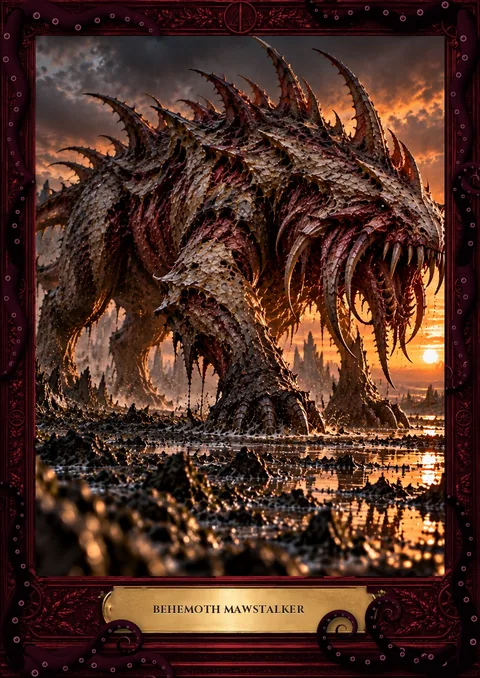
Behemoth Mawstalker
Mostly mouth, plated and spined and enormous, it belongs to the coastal marsh and the mudflats; it never gives chase, but waits at the narrow neck of firm ground between two creeks.
At low water and towards sundown, on the estuary saltings and tidal flats of Kent, and along the edge of the Drowned Lands over the Narrow Sea
Bell in No Wind
On a still, frosty night the chapel bell swings and rings by itself, with frost spreading out from the bell-cote like ferns. The parish comes out with lanterns to the lychgate and looks up. There is no shape to see. This is the ground acting through its own bell.
Small chapels and church bell-cotes on windless frosty nights, where the parish rings for the ground on its old days
Bell Worm
Pale, armoured, and as thick through as a pit shaft, it breaks the face with its mouth already open. The pitmen have a name for it; to what end the name is kept, they will not say.
Wherever a gallery in the coal and iron workings of the Sarrum county breaks through into old ground that no plan records
Black Orchard King
An orchard keeper who saves a failing settlement's crop and then lays down observances, offerings and a rule that nobody leaves. It passes itself off as the power of the place. The trees bear as never before; the people grow old.
Orchards and newly reclaimed fields, at the edge of settlements still finding their terms with the ground
Black Pudding
Slow and cold, a black mass with a wet shine upon it climbs the cellar stair of a works in the small hours and spreads over the floor in the manner of spilt pitch. More than one man who has stepped into it in the dark has come away the poorer by more than a boot.
Below the works of Sarrum, wherever it is cold: the engine-house cellars, the boiler pits and the sumps, and the culvert runs and cellar ways that lie beneath the city
Blackwash
A drain that has gone darker than drains go. At night the black silt in it swells, lifts over the bank and wraps the stakes, and the fen understands that the whole length of the ditch is one living thing. It has no head and no fixed shape, and it is heavy, wet flesh all through.
Derelict drains and flooded reclamation ground on the edge of the northern fen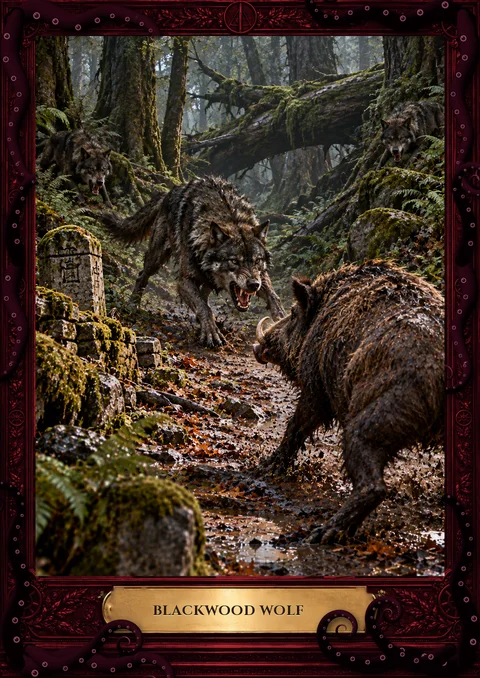
Blackwood Wolf
The swineherds call it the blackwood wolf: a big, dark wolf of the old wood, hunting alone or in a pair, that runs down wild boar. The wood is firm that it is a wolf and no more than a wolf, and deals with it as such.
Wherever swine are run at pannage, and in the old oak of the deep wood along the northern walks and the edge of the middle ground
Bleakhorn
A huge grey wallowing beast with a single horn of bone on its snout and a hide of cracked plates, which lives out in the Drowned Lands and charges the sea walls, and has broken them.
The Drowned Lands beyond the last embanked parish, and the sea walls that face them
Blighted Bear
Swollen, sore along the back and gone past fear, a bear of the kind the country calls turned will run down quarry a sound bear would let be. It fails the shepherd’s questions, which are how an ordinary beast is known, and the march answers it by keeping out of its road.
On the northern walks of the wood and along the fell edge, in wet woodland and the shallows beneath it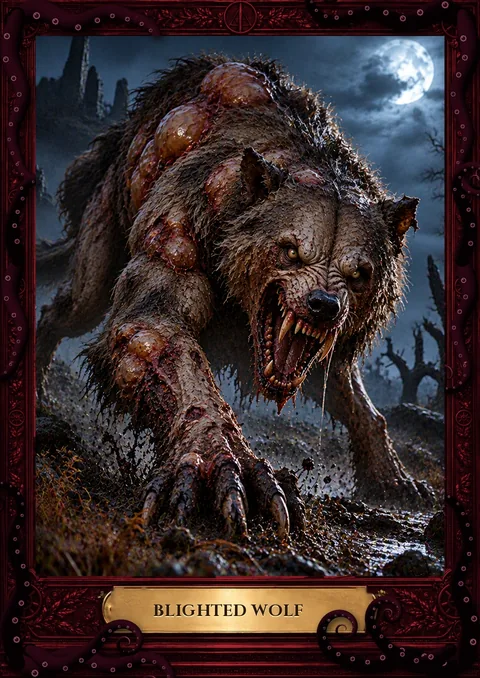
Blighted Wolf
Heavier than a sound wolf and sore along the back, the wolves the dales call turned hunt alone by daylight as readily as in a pack by night. A sound wolf meeting one gives it room, and the shepherds want no plainer lesson.
Along the woodland streams and old bridges of the northern march, and at the fell edge
Blood Leech
In summer a leech longer than a man’s arm and thicker, with a sucking disc broad enough to cover a hand, crosses the flooded roads with smaller ones behind it. The marsh families, who take leeches for a living, leave this one be.
Through the warm months, in the drowned ways and standing water of the marsh at Oxford’s edge and the march fens
Bone Burrower
Pale, plated like a woodlouse from end to end and as large as a cart, it digs with claws that will go through stone. The pitmen named it from the first face it broke out of, which had old bones in it, and have never seen fit to rename it.
Where a gallery or a quarry face breaks into old ground: in the New Lode, where the coal galleries come down upon old iron working, and at the open faces of the Deepcut along the northern edge of the Wold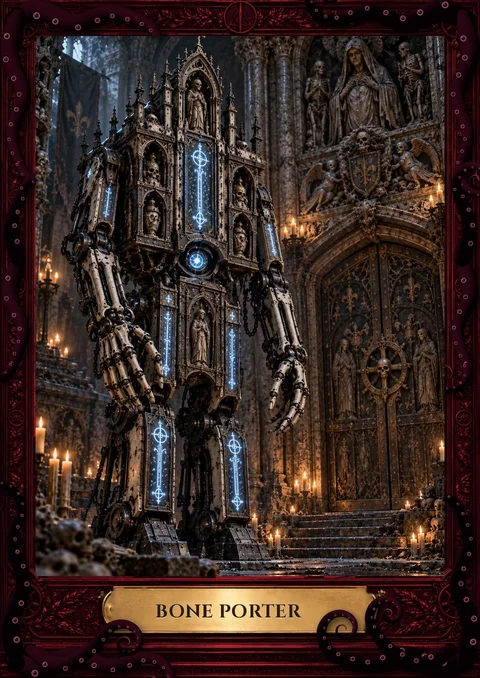
Bone Porter
A walking bier of iron and old wood, shaped like a coffin on four jointed legs, made to carry the bones of an ossuary between their niches and to keep them. It carries with great care. It keeps with less.
Ossuaries, charnel houses and the burial vaults of great churches and houses; it carries and keeps the bones
Bound Thing under the Courthouse
Beneath a county courthouse, in a vaulted crypt, a great stone block bound with iron is carved with seals, and light moves inside it like something turning in its sleep. On a lectern beside it lies the ledger of the dates the seals were renewed. The last entry is the one that matters.
Crypts and undercrofts below old courthouses and guildhalls, sealed in a stone block on a schedule of renewals
Breath Collector
A pair of pale, veined sacs that hang from a ceiling like lungs on a hook and filter the power let loose by long workings carried on the breath. It does not breathe the air of the room. It takes the working out of it, and the working fails halfway.
High in working rooms, laboratories and abandoned chambers where workings are done by breath and voice; it hangs from the vault
Burrower
Up through brick from beneath comes a blind thing, bristled, its claws made like spades. The yards tell of it, the masters fill the hole, and how much hollow ground lies open to it below is a question nobody can answer.
In the footings of the works: beneath sheds, mills and yards raised over old working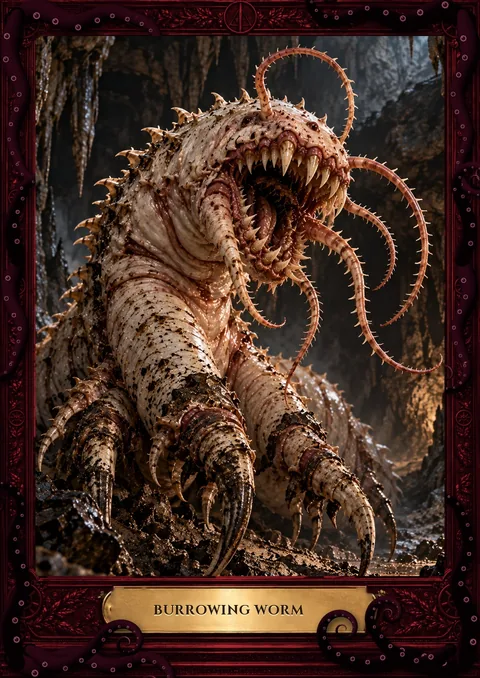
Burrowing Worm
Pale and spined, a worm of the deep workings whose round mouth is fringed with feelers. Men hear it in the rock long before any of them sees it.
In every mining country of the realm, and in the concessions beyond it: old workings, and the caverns they break into
Cairn Hound
Beside a waymarking cairn on the moor lies a great hound made of piled fell stones and moss, lichen for fur and pale light between the stones for eyes. The shepherds walk past it. Strangers who move the cairn find it standing.
Beside the waymarking cairns of the high moor, crouched among the heather or standing on the snow line
Cairncracker
A hunched, bear-heavy beast with a jaw like a smith's vice, which breaks open cairns and moor graves for the bones and cracks them for the marrow. It goes for the living when the bones run out.
The waymarking cairns of the high routes, and the moor graves under them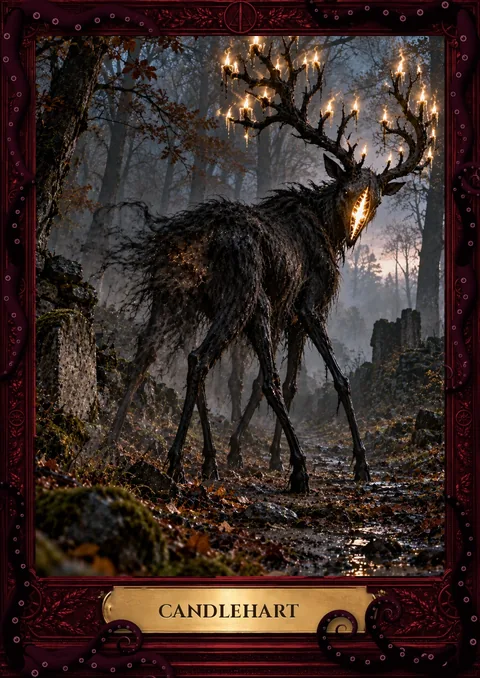
Candlehart
A black stag with a flame upon every tine, which is a power of the wood and is seen walking at dusk. The country does not hunt it; it keeps terms with it.
Uncut stands in old woodland, as the dusk comes on
Captured Trace
In a Cambridge vault, inside a tall numbered vessel of glass and brass, a small living swirl of light and water presses against the glass. It is part of a spirit, taken under a retrieval warrant and kept for study. Oxford calls this preserving a danger on purpose.
The Glassmere vaults at Cambridge, under Lens Row, and anywhere a retrieval warrant has been served
Carr Giant
Antlered and tall, made of moss and branch, it walks the carrs and is taken for a dead tree until it stirs. The reed men hold that it belongs to the carr.
Wet-country carrs, where alder and willow stand in water and old stonework stands among them; chiefly the uncut north carrs of Lantern Mere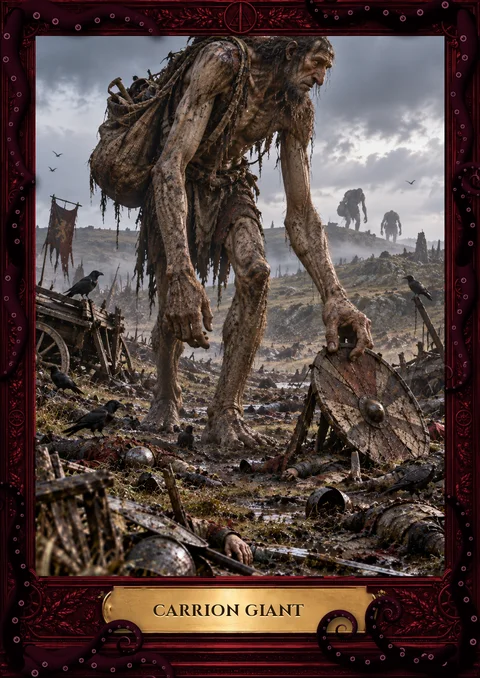
Carrion Giant
Long-limbed, lean and draped in rags, this giant walks a battlefield among the crows, bending over the dead and what they bore. A corpse eater, which is to say a living creature that feeds on the dead, it comes, like all its kind, only where burial has already failed.
Ground where a battle was fought and the dead were left too long unburied; told above all of the Chalkmere ground in the High South
Carrion Marquis
A patron of perfect manners who lends at kind rates, arranges good marriages and gives sound advice, and in whose wake every generation of a great house ends in betrayal. A painting seventy years old shows him at exactly the same age.
Great houses, merchant dynasties and the courts; in a family's portraits more often than in its rooms
Cathedral Eater
A ruined cathedral on the hill that answers the abbey's bell, and one night stands up. The greatest of the things the hunters have names for, and the rarest: what it attacks is the refuge itself.
The ruined abbeys and great churches of the uplands, and the valleys held by a house of the Church
Chalk Eater
A flat, pale, many-legged thing as long as a dog that scrapes and grinds the worked marks off floors and walls. It eats the chalk of a drawn circle and the cut stone of a ward, and the ward fails behind it without anybody hearing a sound.
Ward chambers, crypts and old working rooms where marks are cut or drawn in chalk and stone; it grinds them away
Choir Moth
A moth that lives on the light of worked lamps and warded glass, and so nearly matches the stone it settles on that a verger can dust round it for a year. The choirs name it because it is found in the high vaults where the lamps are never lowered.
Cathedral naves, chapels and lit apparatus; it settles on stone or glass beside a warded light and takes its colour
Church Gargoyle
Clinging to a church tower over a graveyard is a winged figure of carved stone, the kind any old church carries. This one, the country holds, is not always where it was, and lightning is the sole light by which anyone has seen it move.
Old church towers over their graveyards, above all the Kentish towers raised for defence; it is seen to move only by lightning
Cinder Familiar
A low, ash-grey creature the size of a ferret, scaled in patches and long in the tail, that lives in the heat of the works and licks up the charge that leaks from regulators and worked fittings. The furnace hands keep it as a sign, and the examiners count it as a fault.
Furnace rooms, boiler houses and the pipe runs of the works; it lies along hot machinery and feeds where worked charge leaks
Cinder Heart
An inn with a fire that never needs a log, on a road where winters kill. Travellers sleep there and wake more tired than they lay down, and stay another night. Behind the flames, eyes open.
Inns, communal kitchens and winter refuges on hard roads; in the hearth, the flues and the cellar beneath
Cinderhide
A salamander the length of a coal wagon that lives inside heaps still burning from the works, its hide a crust of black clinker and its sweat a boiling tar. It comes out in a close week, when the smoke hides it.
Inside the hot slag heaps and burning waste at the edge of the works
Coal Imp
An imp of the Sarrum works, squat and charcoal-black and stronger than its size has any right to make it, which undoes by night what the fitters made up by day: a joint, a valve, a run of pipe. The works call it bad fitting, and go on calling it so until somebody sees one with a spanner.
By night, in the engine sheds, foundries, pump houses and pipe runs of the Sarrum works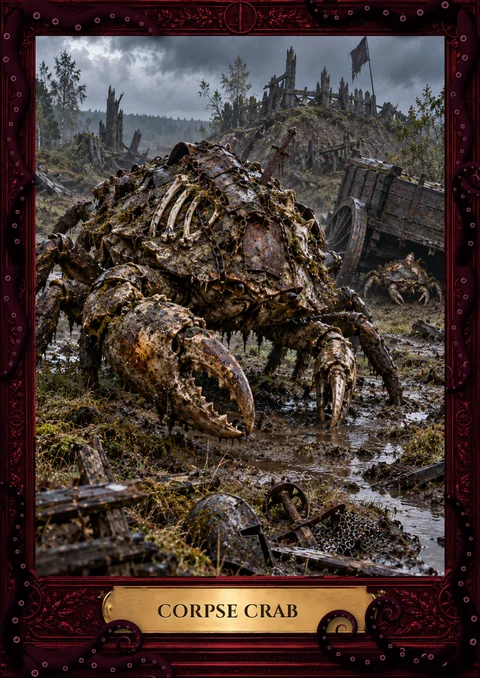
Corpse Crab
A land crab broad as the bed of a cart, its ridged shell the colour of old bone, it comes up out of the wet to feed on the dead, and the landings number it among the corpse eaters. It is a living creature, met most often on the foreshore.
Kent, on the foreshore burial plots of the landings, when the great tides of the dark half of the year come in; and open ground where the dead have lain after fighting or a drowning, at times miles from the water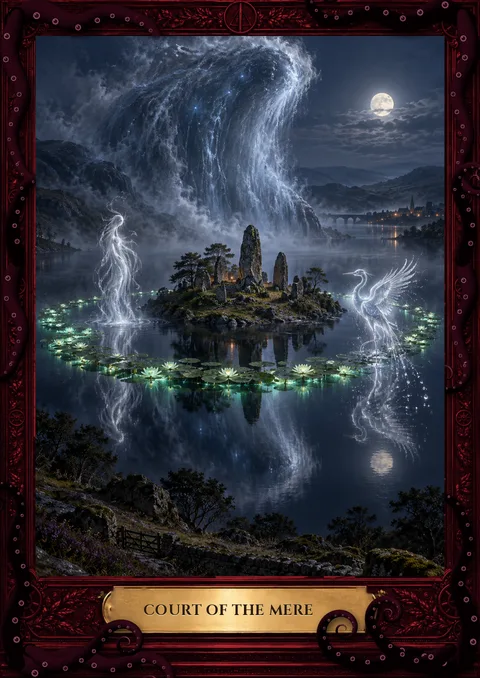
Court of the Mere
On certain still evenings a mere with stones on its island shows several powers at once: a veil of mist, a heron of light, a ring of glowing lilies, and behind them a column of moonlit water greater than all of them. The fen calls it a court, for want of a better word.
A dark mere with standing stones on an island at its still centre; at twilight and by moonlight
Crag Grummock
A shaggy beast that walks on its knuckles, its arms twice as long as its legs and its head sunk into its shoulders, which climbs the steepest hangers and carries sheep and woodmen up the crags to eat.
The steepest beech hangers and the chalk crags above them
Crimson Horror
Low over streets long under water there hangs a red light, and in the light something with too many arms. Whatever a party came for, it leaves behind once that light is seen.
Beyond the Nieuwlanden’s last bank, over the drowned cities a day’s journey north of the towns named for them
Crimson Tick
Starving, it is no larger than a man’s fist; gorged, it is as big as a barrel. It lies in the cracks of a ruin until some beast takes shelter against the wall, and in the morning the drovers find it, swollen to a dark red, lying by the beast.
Wherever beasts are put in the lee of old walls for the night: the ruined shelters along the drove roads, and the empty buildings of old settlements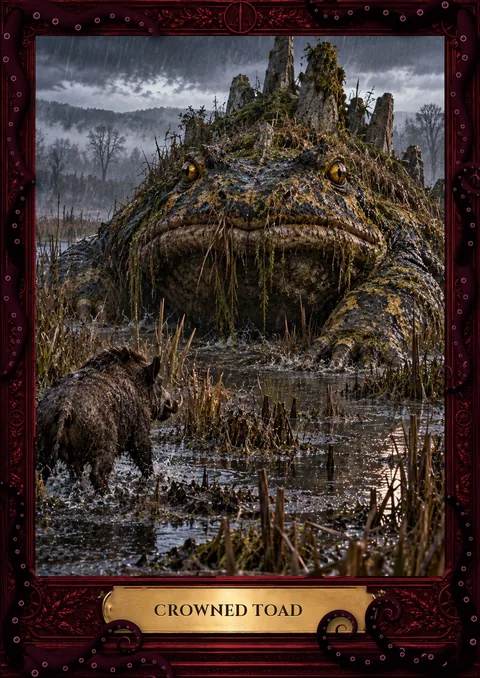
Crowned Toad
It lies at high water among the holms, the fen’s low islands, a toad the size of a cottage and crowned with stony growths, and so still that the fen allows but one way of knowing it from them: a holm does not blink.
At high water, among the far holms and the open reed of the fen; and in the blackened beds of the Oxford marsh
Dire Wolf
Nothing but a wolf, though near twice the size of the rest, which runs with the common packs and brings them onto prey they would never take of themselves.
On the fells and at the wood’s edge in company with the common packs, and pacing the chalk droves
Dragon of the Black Marsh
The marsh calls it a dragon and the Reed Cross writes it down as a beast, and both are wrong. It is a lizard as long as a barge, on six legs, with a ruff of skin about its neck that it raises when it charges, and scales split open by weeping sores.
The dead reed country of the Black Reeds, where the beds have been sick longest
Dream Shade
A lodging house where the dreams are the most beautiful anyone has ever had, and the guests sleep for days. One woman walks the landing with her eyes shut while another voice speaks through her.
Boarding houses, sickrooms and any bed slept in too long; and the sleep of whoever lies in it
Drowned Mother
Smooth, slate-grey, the length of a barn, it heaves itself out of the floodwater onto the roofs in a high-water year, with small pale things clinging about it.
Drowned hamlets and flooded ground where the water came in and never went out: the flashes of the Sarrum coal country, and the Oxford marsh behind the line
Fat Imp
Toad-like, squat and bloated, its mouth too wide for its body, it feeds in the drains upon all the city casts away. Of the imps it is the most told, which is only to be expected, since the drains employ more people than the church roofs do.
Under Sarrum and London, in drains, culverts and old channels, wherever the city’s refuse runs away below
Fen Bride
Among the stones of a churchyard gone under the water stands a pale woman in a rotted wedding dress; and every water that has her tells of a different wedding.
Churchyards gone under the water: the coal country’s flashes, and the drowned ground of the Oxford marsh
Fenrake
A hairless, heavy-bodied thing with forelimbs twice the length of its body, each ending in a rake of hooked claws, which drags the shallows of the meres for eels, nets and anyone wading.
The shallows and eel grounds of the northern meres
Feral Bear
Bears are not among the troubles the hanger country counts, yet here is one, enormous, raw in the hide and beyond the reach of fear. Since nobody but the charcoal burners is in the hangers once night has fallen, it was the charcoal burners who first set eyes on it.
Wet ground and combe bottoms in the hanger country, down where the combes open on the vale; abroad only in the dark half of the night
Feral Boar
Nobody’s grandfather saw a boar of such size, and no wall turns it: it goes through. Talk of boar-things in the hedged country has run through the western counties since 4619, and the valleys of the High South have lately begun to give it an ear.
Quiet farm country within its hedges, where holdings are given up, the lanes unkept, and the farmsteads left standing
Feral Bull
Owned by no one, its horns unmatched and its hide in ruins, this bull comes out of an empty steading at herd, horse and cart upon the drove. To the drover courts it was a straying case, and there was no owner to be fined.
Steadings standing empty on the Wold and Downs of the Sarrum county, with the droves that pass them by
Feral Crocodile
A huge crocodile whose teeth sprout from its jaws in all directions lies among the drowned buildings of the flashes, and comes at boats and dogs and men ashore without distinction. The drowned gables have been shunned by the flash families for a long while, and no one now asks the reason.
Among the drowned farms, lanes and gables standing in the flashes of the Sarrum coal country, and in the reeds at their shallow ends
Feral Eagle
Larger than any eagle a fell ever bred, malformed in beak and talon and red-eyed, it roosts by itself in church towers and drops through the roof onto whatever lies below. Ringers are the ones who meet it, since in a lapsed village the bell is the last thing anyone still walks out to keep.
March church towers rung still though the villages round them have lapsed, and the roofs of ruined churches close by; always solitary, never followed by birds
Feral Horse
In full daylight a black horse comes down the market street through stalls and barrels and people, mane wild, hide broken, with teeth that belong to no horse. Kent hangs horse thieves, yet no one has ever claimed this horse.
Old Wealden towns with half-empty market streets, and the lanes no carter will take after dusk
Feral Hound
Heavy, raw in the hide, with the head of a mastiff, this hound keeps an empty house and comes down the stairs at anyone who opens the door. Of any kind he keeps, says the huntsman at Wye, it is none.
Halls and great houses standing shut while their owners write from London; up and down the stairs and passages of a house no one attends
Feral Ram
Turned, the dale calls this ram: horned past any breed, afraid of nothing, it breaks through a fold gate at the flock and after that at the shepherd. On the wold it is the single thing the upland’s turning does not turn.
On the High Wold above the drove, at roofless folds and their gates, for the five months the flock spends up there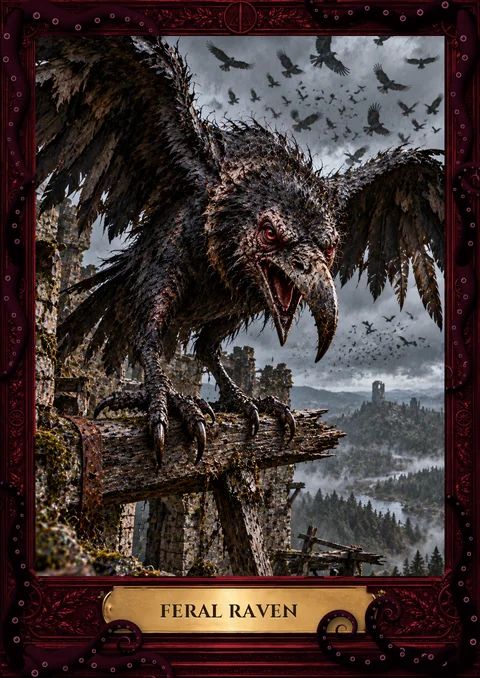
Feral Raven
Large as an eagle, with beak and talons grown awry, this raven strikes at shepherds and dogs, and the crows of an entire valley follow it down. The march’s oldest manner of reading a ruin it has spoilt.
Above the drove, at ruined folds, bield walls and roofless buildings, and in the valleys beneath, with crows wheeling behind it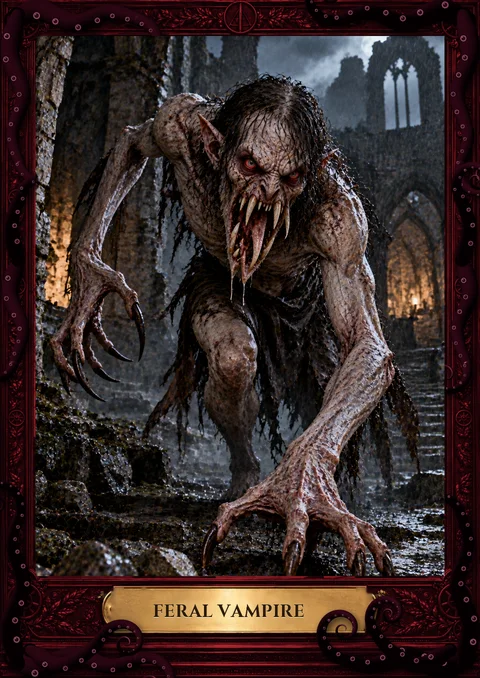
Feral Vampire
Here is a vampire, that is, a living person laid under a curse, who has passed beyond all control: long of arm and nail, crooked of fang, crazed, killing well past any hunger. Ordinary vampires the realm reports as a rate; this kind it reports as a scene.
A ruin a night’s walk or less from the house it lived in: an abbey’s shell, a gutted chapel, the undercroft beneath some fallen great house
Feral Wolf
This wolf kills and does not eat. The woodwards of Wychwood know it by a stag left lying whole across a ride, and by the dogs, which it goes for before anything else.
Wychwood’s middle ground, where the worked wood gives out, and the dead rides beyond it
Ford Bride
Over the whitewashed stones of an old ford the morning mist stands up into the shape of a veiled woman, her veil falling water and her hands reeds. She is no drowned bride. She is the power of the crossing, and the crossing is safe on her terms and nowhere else.
At old shallow fords with whitewashed stones, at dawn and in river mist; most of all where a new bridge has taken the traffic away
Forest Horror
High in the deep wood, among the branches, a darkness hangs with small lights in it. It has never been told the same way twice.
At night, in combes the ridings never enter and on ground the woodwards go around
Frost Walker
On certain mornings a great branching pattern of hoarfrost runs across one field and over its walls, like a fern the size of a meadow, or like something walking. There is nothing in it to talk to. The parishes that have such a field keep their sheep off it.
Over certain fields and stone walls at first frost, at first light; the same fields every year
Gallowkite
A great raptor without a feather on it, its wings stretched skin like a bat's and as wide as a barn, its beak toothed. It nests where the realm once hanged men and carries off sheep, dogs and, in the old tales, the hanged.
Gallows hills, gibbet posts and the ruined towers above old execution ground
Gallows Polyp
A swollen mass of flesh hung from oak limbs or the ribs of a roof by a crown of anchoring cords, with dozens of tentacles of every thickness dangling below. It has no head and no eyes. It lowers its thin feelers onto what passes beneath, and lifts what they find.
High in the canopy of the deep Weald, and under the vaults of ruined chapels and halls
Glass Confessor
A gentle listener in a hospice or a parish who knows what you have never told anyone, and offers to take the weight of it away. Each time the relief costs a little more. Its skin, when the light catches it, is glass.
Hospices, charitable houses and sickrooms; wherever people come to be listened to
Gorestrider
A flightless thing taller than a horseman, featherless and long-legged, with a hooked beak like an axe head. It runs the open sheep marsh at dusk faster than a horse and kills with one blow of the beak.
The open sheep marsh behind the sea walls, at dusk
Gorm of Crowdyke
The largest thing the march will name: a hunched, plated, tusked colossus the size of a chapel, seen perhaps once in a generation, which some in the march say is what broke the gate at Crowdyke.
The fallow ground beyond the old blockhouse at Crowdyke
Grasping Vines
Growth armed with thorns, which moves, and pulls whatever it holds down into the earth. In Wychwood it is told of the no-cut belts and of the ruins within them.
Overgrown ruins, and the edges of Wychwood’s no-cut belts, which are the strips of old woodland the people of the wood never touch
Grave Current
A moving mass of small, pale, blind eels that runs through wet graveyards and over the walls of ossuaries, following the worked power laid into burials. It is not a haunt and not the dead. It is hungry, and what it feeds on is what keeps a grave quiet.
Wet churchyards, ossuaries and charnel walls; a colony moves through the ground and over stone towards the worked niches of the dead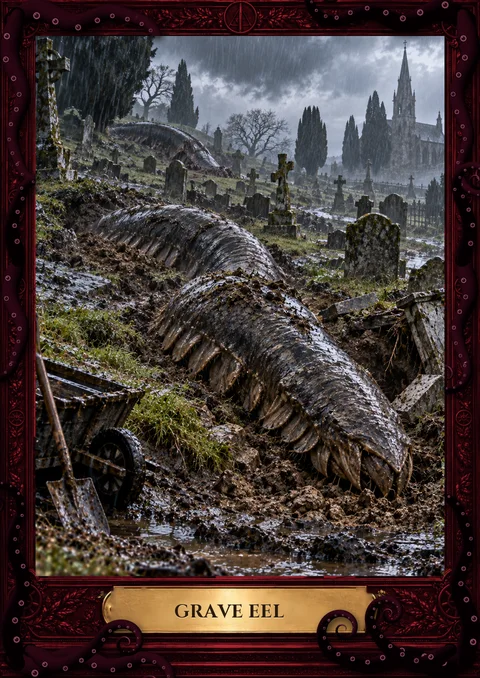
Grave Eel
Through the sodden ground of a churchyard it goes sideways, a segmented burrower as thick as a man is round, breaking from one grave into the next. It is a living creature, and feeds upon the dead; that, and nothing further, is why the sextons number it among the corpse eaters.
Burial ground that is wet and overcrowded: the parish ground at Dover, full past use, and the burial islands of the northern fen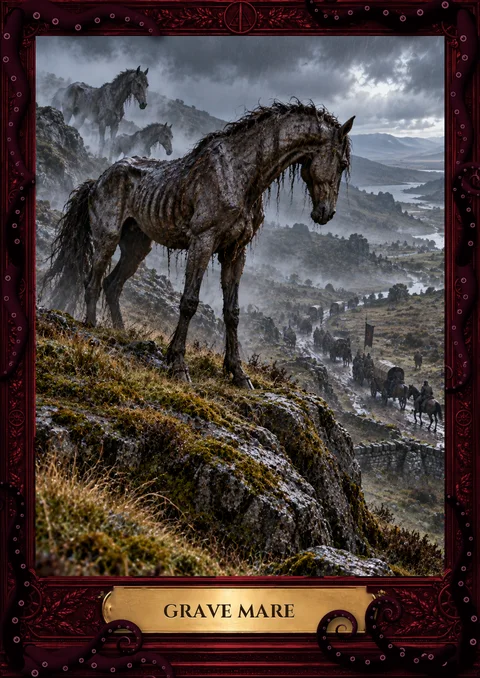
Grave Mare
It stands on the high ground over a road, a gaunt thing in the shape of a horse, lean to the rib, and watches what goes by below. It eats the dead. That it knows which drove will leave somebody behind is the drovers’ belief; the priory replies that every drove does.
Bare upland in mist above the roads and droves, wherever a drove, a carriage or a column goes by that may leave its dead behind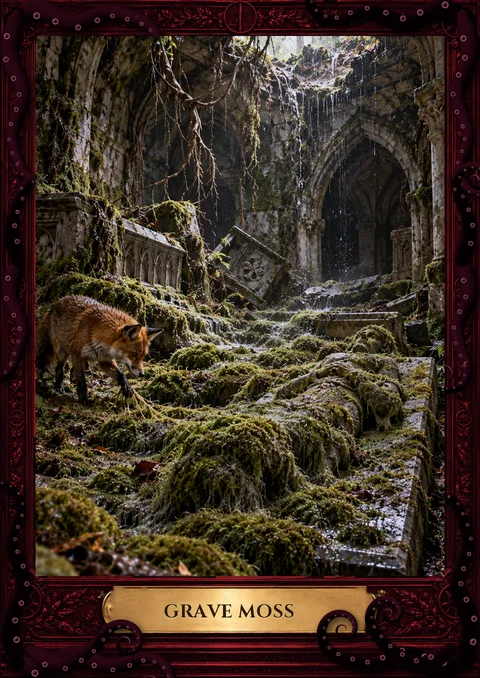
Grave Moss
Wet and deep and creeping, it carpets a ruined church from one wall to the other and keeps hold of whatever lies down upon it. A fox may cross it safely. A weary traveller had better not sleep on it.
Roofless chapels, and old burial grounds gone out of keeping, where it lies over the ledger stones and the tumbled tombs
Great Worm
As tall as a church tower, with a round mouth that is a ring of hooks. Men on the last bank give it as the reason why no two charts of the Drowned Lands agree.
The Drowned Lands beyond the last bank, as the tower line of the Nieuwlanden sees them: drowned ground that was never won back
Green Face of the Wood
In the oldest woods, the canopy itself sometimes becomes a face: a calm brow of branches, cheeks of leaf and moss, eyes of dappled light, many feet high, looking down at a whitewashed boundary stone. Nothing walks. The wood is the face.
Over the no-cut belts and the oldest uncut stands, seen from below a boundary stone
Hairy White Ghoul
White as the drifts it waits among and long in the hair, this corpse eater of the snow country comes, the upland says, when the dead cannot be buried, and is the hardest of its kind to see.
Wherever a body lies above ground awaiting the thaw: in the high dales and the fell farms, in a hard winter
Hangman's Willow
Whatever passes beneath this great willow of the wet wood, be it boar, calf or dog, it takes and lifts into its branches and holds there. The name is the country’s, given for the look of the tree with something hanging in it.
The carrs, which are wet woods standing in water, and the backways along the drove banks that run through them
Hidebound
A long, many-limbed thing with a hide like wet black leather, grown in the old tanning pits, which comes up through the pit floors and drags whatever it catches back down into the liquor.
The disused tanning pits and lime yards of the lower wards
Hollow Choir
Over an old field a singing without words is heard, and only afterwards is the line seen: four-legged shapes bearing light where their heads should be.
In fog, upon old fields where armies fought, and on the ridges and crossings that border them
Hollow Magistrate
A judge who came from nowhere and made a town orderly, and under whose hand prisoners began to confess, all in the same words, to things that cannot have happened. The hunters' name for it is the Hollow Magistrate, from what is under the robes.
Market towns and county seats, wherever a bench, a register or a chapter office has lately changed hands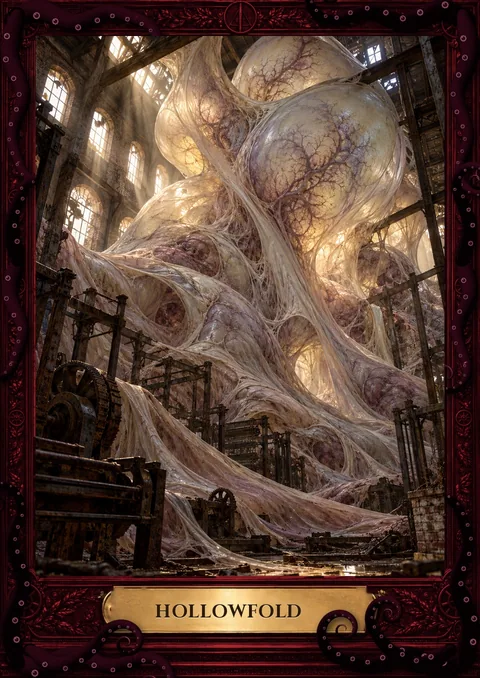
Hollowfold
A heap of what looks like rotten cloth in a disused drying house. It breathes. Bladders rise out of it to the roof beams and sink again, sheets spread across the floor and up the walls, and a man who has walked into the room finds that the folds have closed every way out.
The abandoned drying houses and bleach yards of the cloth trade
Horned Trunk
A beast the bulk of a dray horse and twice the weight, on four great legs, with no head at all. Its horns grow straight out of its shoulders, a fringe of long feelers sways above them, and its mouth is a slit down the middle of its chest. It charges horn first, and nothing in an old barn stops it.
Abandoned threshing halls, quarry yards and the dead works at the edge of Sarrum
Hydra
Black, three-headed, a serpent-dragon of the marsh water: the oldest kind of story, which the causey households tell as if it happened last year.
Beyond the line in the Oxford marsh, where the city’s drained ground gives out; and the drowned ground of the Cut by Reedgate, where the water came in and stayed
Iron Beadle
A warden of iron set to keep a gaol corridor or a strong passage, with four arms that end in hands and in the barrels of guns. It was built to keep order, and it keeps the last order it was given whether or not anybody living still wants it.
Gaols, lockhouses and the corridors of guarded offices; bolted to a ceiling or rolling on iron wheels along a passage
Iron Golem
Something made, though by whom the realm cannot say: a giant of riveted iron with a great hammer, its seams aglow as though a furnace burned inside, which keeps watch in a ruined town and stirs when anybody enters.
Where it was set, in ruined towns and on old fortified ground; and in the reports of the salvage companies that went in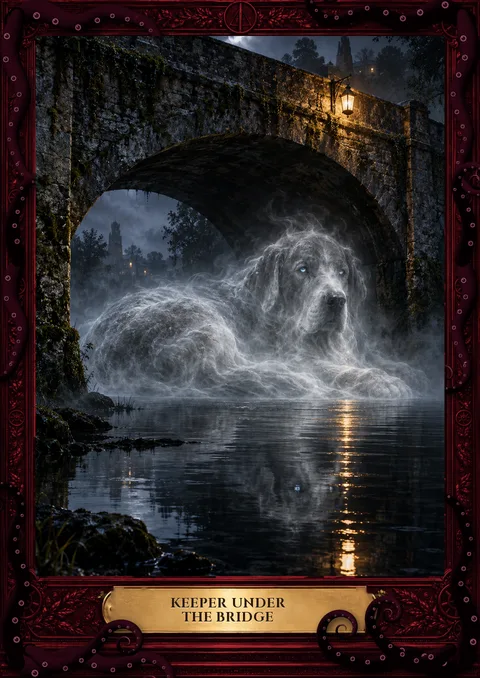
Keeper under the Bridge
Under the middle arch of an old bridge, at night, something like a great curled hound of river fog and stone dust lies on the black water, with two calm lights for eyes. The bargemen call it the Keeper and keep the lamp on the parapet lit for it.
Under the arches of old stone bridges, most often where a ford was before the bridge; by night, under the parapet lamp
Lady of the Pool
Seen as a woman standing waist-deep among lilies with flowers in her hair, she is the power of a woodland pool. A lady's title is what the country gives her, and her terms it keeps to the letter.
At the foot of the hanger combes, in woodland pools beneath falling water
Lamp-Leech
A leech as long as a man's forearm that fastens on a sealed lamp or a fitted machine-stone and drinks what keeps it lit. The lamp does not go out at once. It dims, night by night, until the lamplighter blames the examiner and the examiner blames the lamplighter.
Stair lamps, chapel lamps and the warded fittings of cellars and crypts; wherever a sealed lamp is left to burn unwatched
Lantern Belly
Long and low, six-legged, with a swollen belly that shines; at a distance it is taken for a lantern carried low across the marsh water.
By night, on marsh water wherever lights are seen: the Bone Marshes by Sarrum, the inner dykes of the Kentish levels, the meres of the north
Lantern Hound
A hound of iron and brass with a lantern in its chest, set to walk the round of an estate or a watched road at night. It finds what does not belong, lights it, and holds it. What it does after that depends on what it was told, and the people who told it are often long dead.
Watched roads, estate gates and the walls of great houses; it walks a round and lights what it finds
Lantern Skimmer
A pale green light moving above the roofs in a river fog, where no lamp should be. Under the light is a living mantle as broad as a barge's sail, dark above and pale beneath, trailing cords, with a slit of a mouth on its underside. It drifts down onto whoever is alone in the lane.
Over the lower Thames and the estuary flats, in fog, above the warehouses and cranes
Lantern Spider
It hangs in the timbers of a flooded level like a lamp upon a nail: a pale cave spider with legs the length of pit props and a swollen body that gives off light. The hewers have learned to know that light from a lamp’s, and their rule against it is a matter of counting.
Wet levels in the deep workings, with water lying between the rails and the timbers grown old: under Blackdown, and in the deep workings of the concessions abroad
Lean Grey Ghoul
Of all the corpse eaters the commonest: a grey, starved, long-limbed thing that stands at a lane's edge in poor light, in the very place where a man expects to find a beggar.
After rain, in wet back lanes, in cellar runs and at the edges of ground that is going bad; found the realm over, and most of all beneath the cities
Many-eyed Orb
Out of the mist over still water rises a great globe of eyes. Those who tell it never say the eyes were looking at them, only that the eyes were looking.
Out over a still mere at night, as watched from a staithe or a causey station
Manyback
Lying across a forest road as a fallen trunk lies, a many-legged armoured thing of wagon size, grown over with moss, waits for the carts and takes whatever they were carrying.
Wherever a road is going back to the wood: on forest roads, and on rides near old ruins
Marked Ferryman
An old ferryman in oilskins, sworn to his water, whose eyes hold the river's light as though it were inside him. He is not possessed. He knows where the river will be safe tonight before the river does, and his moods are the water's moods.
At the tiller of an old river ferry, on a crossing kept by one family for generations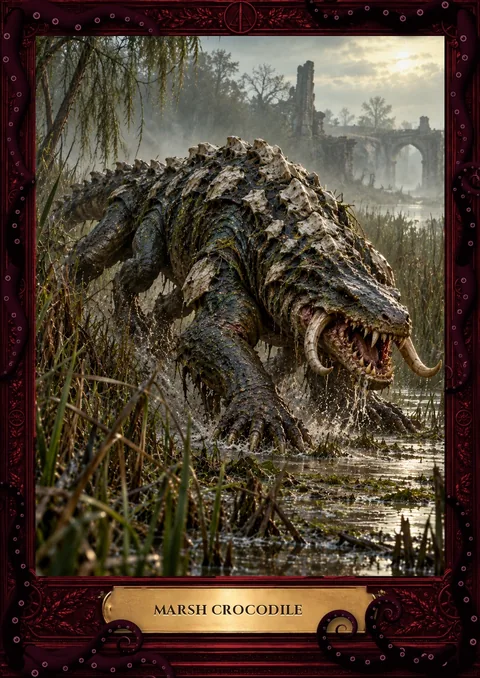
Marsh Crocodile
Tusked like a boar, long and armoured, as patient as a fallen trunk, this lizard of the drowned country lies along a cut in the likeness of a log; hence the reed cutters count their logs.
Beneath old causeys and broken bridges, in the reed cuts and slow water at the fen’s edge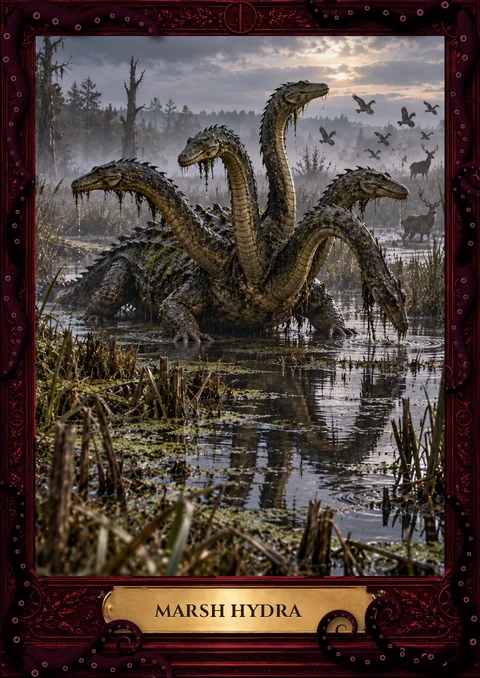
Marsh Hydra
The fen tells of it not as a dragon but as trouble at a decoy: a long, low thing with four heads, lying in the shallow water among the reed, its necks stretched along the surface like so many broken stems.
The shallow reed water of the fen, along the edges of the meres and in the eel channels, where it lies low among the stems; fowlers and eel men are the ones who meet it
Marsh Lights
A line of soft blue-green lights crosses the marsh at night, each like a lantern carried by nobody, the whole line moving as one long creature. It is one wandering spirit going between its waters, and it goes over pools no man can cross.
Across flooded reed marsh at night, along lines no causeway follows, from one deep water to another
Marsh Stalker
Tall, bony and spined, a marsh thing all ribs and teeth, which keeps very still among the reeds; that stillness is how it hunts.
The open marsh beyond the line at Oxford, at sunset; told chiefly where the Reed Sickness has taken the beds
Maw Crawler
Pale, spined and many-limbed, a cave thing with a mouth too great for it, which lies where the air never moves and comes out at a lamp.
Caves and deep workings where the air lies still: the caverns off the deepest shafts of the Sarrum county, and the swallow-hole hollows into which the quarries cut
Maw Mole
It breaks up through a lane beneath a laden cart, a digger the bulk of a bullock, dark of fur, its forefeet set like a row of hay-forks and its snout opening into a ring of pink and fleshy fingers. Yet it is less the beast the valleys fear than the hole it leaves behind.
Wherever the ground above the chalk lies dry enough to dig: the lanes and fields of the chalk valleys and the tithe country, and the Wold shoulder over them
Mire Giant
Taller than the dead trees among which it wades, gaunt, man-shaped and draped in weed and moss, it walks the open marsh when there is fog. From their boats the mere families have watched it, and they say it has never once come towards one.
Beyond the causey line at Oxford’s edge in the open marsh, among the meres and the dead trees standing in water; only ever in fog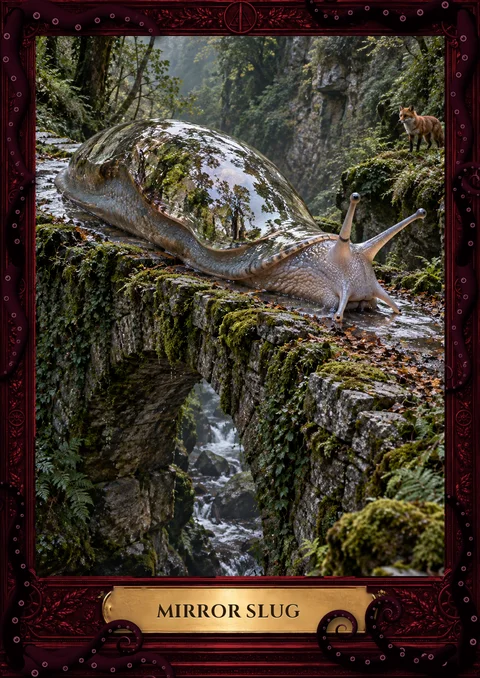
Mirror Slug
Pale and soft beneath and as long as a cart, it carries upon its back a great dome that shines like a mirror and shows, not the slug, but the wood around it. It crosses the old bridges of the wet wood in daylight, and when anybody notices it, what he notices is a piece of the wood that is not in its proper place.
In wet woodland where streams run in deep cuts: Wychwood’s middle walks and the old bridges of its rides, and the stream cuts of the hangers of the High South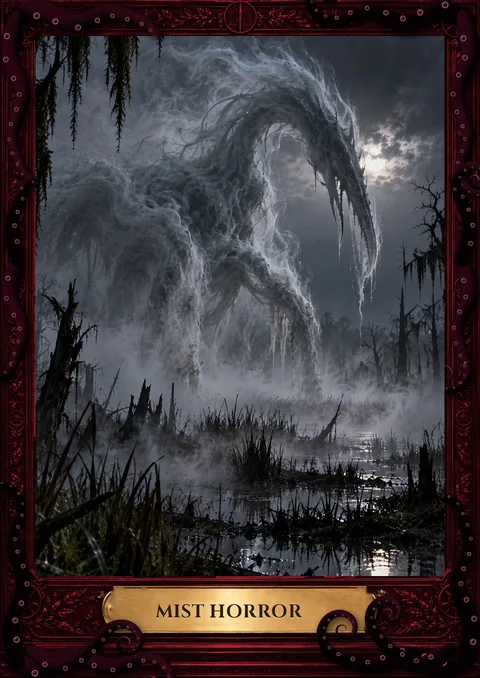
Mist Horror
Made of the very fog it moves in, tall, long-necked, many-legged, it is gone when the fog lifts. This is what the fen says walks in the tenth day, that one fog in ten which comes in against the wind.
On the fen holms and the meres when the fog is down, through the darker half of the year
Moorgaunt
Twelve feet at the shoulder, every rib standing through its hide, with a crown of bone grown out of its skull in branches like a dead tree. It grazes like a beast and hunts like one, and the drovers measure the season by whether it has been seen.
The high wold above the summer grazing, in the mist
Mossmaw
In the drowned water, a moss-hung bulk with a single pale eye and a curtain of feelers in place of a mouth. Coloured like the water, it stirs only when it chooses.
Among drowned trees and under the moon, on the flashes of the Sarrum coal country, the sunken pools over worked coal
Moth Imp
When something within an empty manor grows restless, small imps of the night come round it in numbers, on broad and dusty wings. A sign of the trouble, say the Wardens of the Quiet Ground, who count them; not the trouble itself.
Shut houses and empty manors by night, where some other thing is already showing itself
Mother of Unfinished Faces
Everybody's grandmother: soup for the sick, knitting for the children, a kind word for the lonely. The young people who mean to leave town never quite manage it, and from the empty room upstairs come several voices at once.
A warm house at the end of a lane, with a kitchen everybody visits and an upstairs nobody does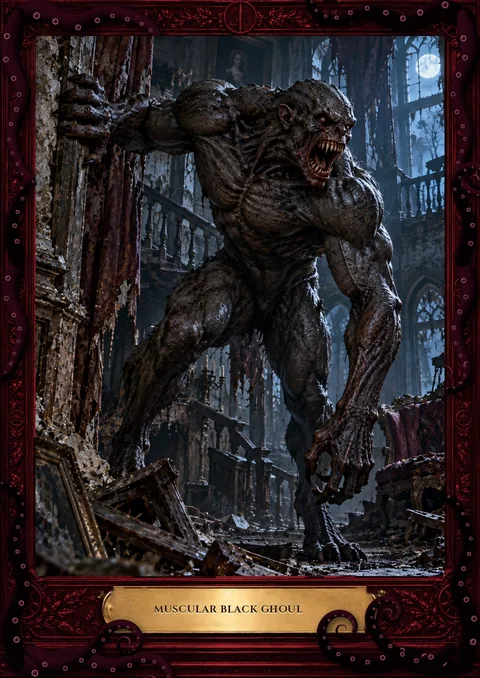
Muscular Black Ghoul
Heavier than the rest and dark of hide, broad as a smith, this corpse eater holds the lower rooms of a ruin and rises through the floor; on its account a clearing party goes in only by day.
Below old buildings: in the undercrofts and cellars of house ruins, and in the broken ground beneath them
Mutated Serpent
The soberest witnesses say it takes bears: a serpent grown far past any serpent’s size, its coils broken out in sores. Its head has never been brought in.
Where the fen comes up beneath the wood: in the carrs, the wooded wet ground
Needle Imp
Pale, small and long in the limb, it lives in a disused church’s rafters and comes down the walls head foremost. The lead thieves, the only men who climb that high, are the first to meet it.
Up in the roof timbers of disused churches and chapels, where the roof still stands
Night Drinker
Down off a barn roof onto the cattle glides a large four-legged beast of the night, broad skin stretched between its limbs, and drinks from them. The dales reckon it among the reasons the march builds its byres into its houses.
By night, wherever cattle are kept in: the stone barns and byres of the dales, and those along the drove roads
Nosferatu
A vampire so far gone from the human shape that it could be nobody’s neighbour now: stooped, lean, long-fingered, and with a mouth fashioned for feeding. The hunters are careful with the name, for the thing it names is still somebody.
Below ground in the old drains and undercities of the great towns; and by night on the walls and roofs of empty great houses
Old Watch of the Ridge
In summer the Old Watch of the ridge walks as a pale wolf above the pack. In winter, the drovers say, it stands up out of the snow on the crest, taller than any church, with a cloak of spindrift and two cold lights where a face should be.
On the bare crest of an upland ridge in winter, above the cairn where the drove road turns
Orchard Keeper
A tall thin figure of woven apple boughs and blossom unfolds from the branches of an old orchard at night, lantern light in its leaves and no face, only a hollow. It sorts the windfalls, props the old limbs and stands in the way of the axe. It is the orchard's servant, and no demon.
In the oldest orchards, at night, beside the oldest tree; where the ground keeps terms older than any lease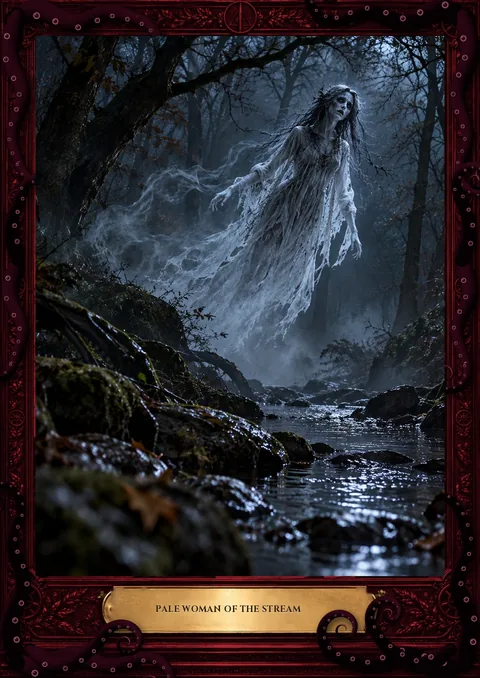
Pale Woman of the Stream
Seen at dusk above a woodland stream, a woman of mist drifts always downstream, and never twice in one reach. She has harmed no one; yet the millers stop their wheels for her.
Above running water at dusk, on woodland streams and the bournes of the valleys
Pallid Ghoul
Pale and hairless, going crouched, with a skull for a face: the corpse eater of church ruins and of old graves that nobody tends any more.
Roofless chapels, and the old graves round them where the dead have lain long since the last service was said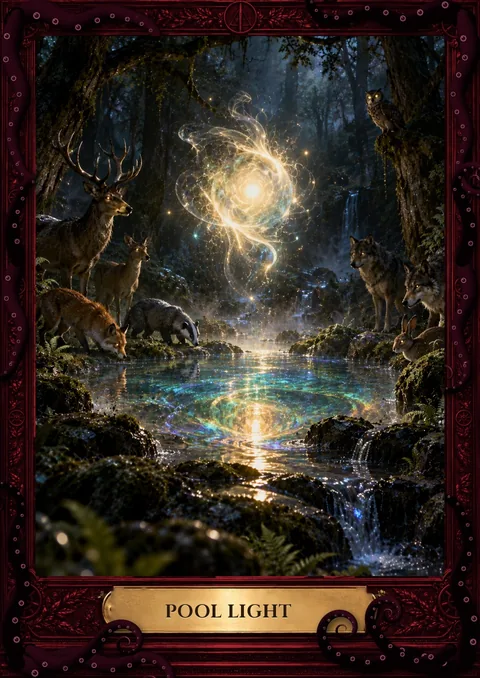
Pool Light
Above a woodland pool a light turns, and the beasts of the wood stand quiet about the water's edge. The light, the wood says, is the spring's own.
By night, at springs and pools deep within old woodland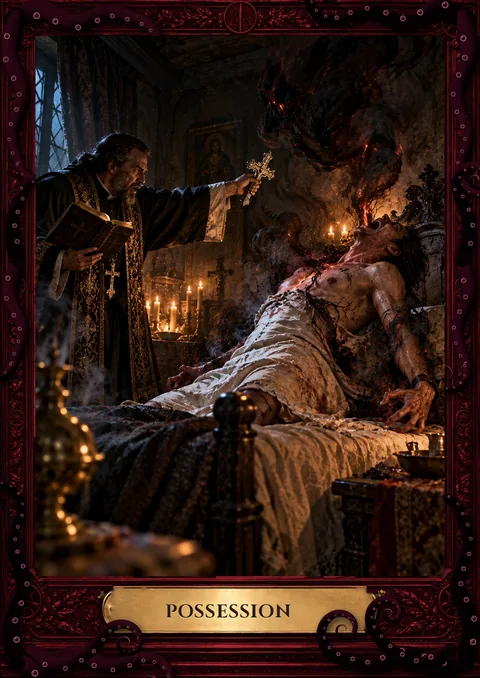
Possession
Each county has a word for it and the Church a rite, and still no court in the realm will rule that it has ever happened; for it is no creature, but a thing done to a person.
Someone the household has known all its life, in a house, at a bed
Ragwing
Ragged, winged and long of limb, it clings in storms to ruined towers and religious houses. The crows rise when it comes, which is how the country knows of it.
Ruins that stand high, a tower on a hill or a religious house upon a ridge, and storm weather above all
Red Briar
Over an abandoned cottage grows this living thicket, red and hooked, catching whatever comes too near: a sheep, a dog, a stag by its antlers. The country reads it as a sign that the ground was given up a long time since.
Abandoned cottages and holdings on ground given up long ago, and the old thorn lines on its border
Red Carrion Ghoul
Squat, rust-coloured and a burrower, this corpse eater is seen most often half out of a grave, and the quarry country's sextons hold it the boldest of the kinds.
The churchyards of the wet and quarried chalk and limestone country, where it rises through the turf from beneath
Red Drake
Low and long on four legs, a red drake scaled and spined, which comes out of the wet ground for horses and goes back into it.
Along the droves, where moor and marsh edge meet the grazing: the Sarrum county’s horse country, and the mosses of the march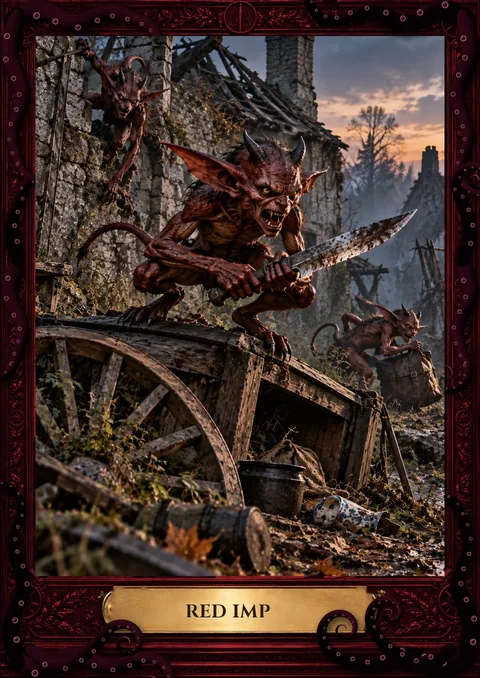
Red Imp
A small imp, dark crimson and long of arm, that scavenges empty farms for their tools and takes the bladed ones before the rest. Kent suspects the evicted tenant before anything else, and has paid more for that mistake than ever it lost to the imp.
Deserted holdings and farm settlements, among carts, barns and tool sheds that nobody watches any longer
Red Slime
It comes for the warmth of a furnace mouth, a crimson jelly with a wet shine to it, and spreads over the floor there and hangs in strings off the steam pipes, until the furnace hands shovel it into the fire. The Collegium has never yet managed to say what it is.
Wherever a furnace is kept in through the night: the furnace floors of the fired-material yards of Cambridge, and of the ironworks of the Sarrum county
Red Widow
Out of feral ground and into the last farm buildings at its edge comes a thing the size of a man, its narrow body held high on long spider’s legs and, behind, a great swollen belly of dark red in which it keeps what it drinks.
On the border of ground the district has given up: ruined farmsteads, and the folds and byres closest to them
Redham Leech
A leech as large as a calf, banded black and rust, which lies in the ford pools at Redham and fastens on whatever crosses. It can drain a horse before its rider has reached the far bank.
The middle crossing of the fen at Redham, and the ford pools there
Reed Heron
A grey heron taller than a man stands in the reeds at dusk, with reed stems growing through its feathers, at the edge of a cut the reedmen leave alone. It is a living bird, and it keeps the ground of the marsh's power.
Standing in the reeds at a marked cut, where the safe ways through the marsh end at deep water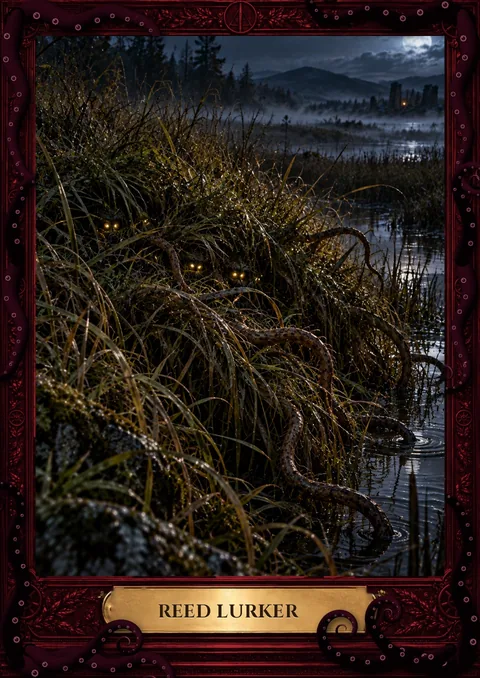
Reed Lurker
Two or three pairs of yellow eyes, low among the reeds at dusk, and beneath them something long that reaches from the water. By the reed men’s account, it keeps the uncut reed.
Reed beds at the water’s edge at dusk, and the reed the fen leaves uncut; told chiefly at the meres and their decoys
Reef Mother
In a storm at the mouth of a channel, the surf over the reef stands up into a vast shape with arms of breaking water and kelp and a calm face in the foam. The sloops that know the coast keep to the one channel marked by a lamp on a pole, and give her the rest.
The reefs at the mouths of the southern channels, in storm; seen from the one safe channel, marked by a lamp on a pole
Reliquary Tick
A tick that hides among the silver of a reliquary, a censer or a sealed casing and slowly drinks the worked power from it. The seals are untouched, the object looks as it always did, and it no longer does what it was kept to do.
Treasuries, crypts and shrine cupboards; it lies flat among the metalwork of a reliquary or a sealed casing
Root Horror
In a ruined doorway, as if grown there, stands a tall shape of root and sinew bearded with feelers. The clearing parties tell it, each differently from the next.
A ruined farmstead at the far end of an old fallow, once a parish begins to take the ground back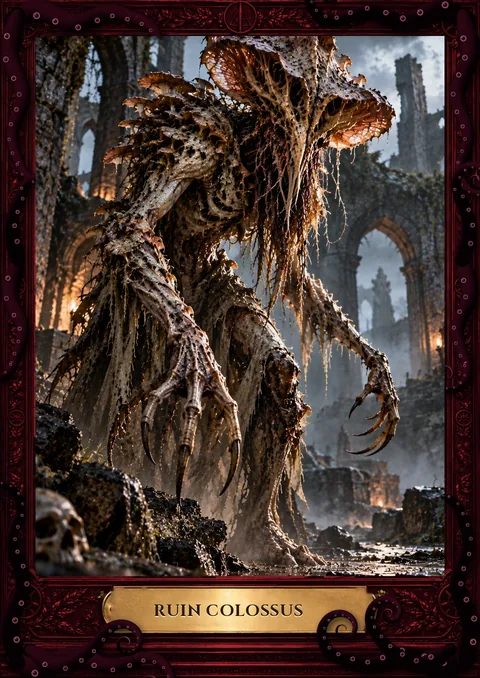
Ruin Colossus
A giant of root and bark and feelers, which walks in the largest ruins of the march and never goes out of them. Salvage that nobody has taken is how the country marks it.
The greatest ruins of the march, where the walls stand yet to the height of a nave
Ruin Giant
Grey, bald, long-eared and of massive build, a giant is seen leaning from the trees over the deserted cottages of the Chase woods, deer standing quietly at its back. For all that arises on it the Chase keeps its own courts, and before them this has never once come.
In White Hart Wood, inside Hartfell Chase, among old beech and oak beside moss-roofed cottages empty beyond memory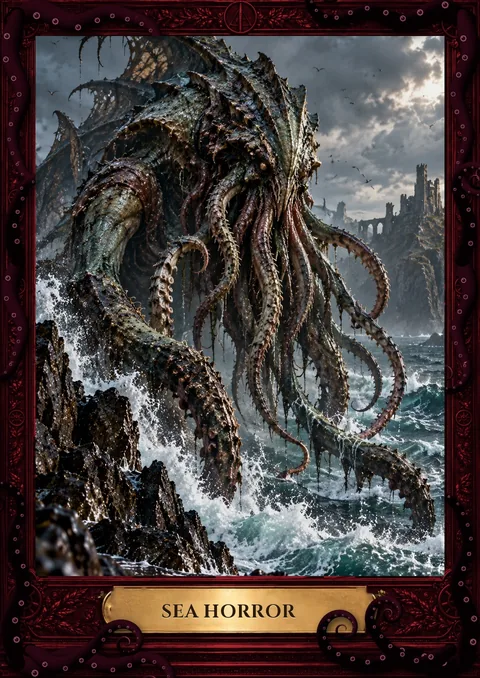
Sea Horror
Among the timbers of a new wreck something comes up out of the surf. No two landing parties describe it alike, and the coast holds that their disagreement is itself the reason to call it no beast.
Off the Kentish shore, upon the rocks and in the wrecks they gather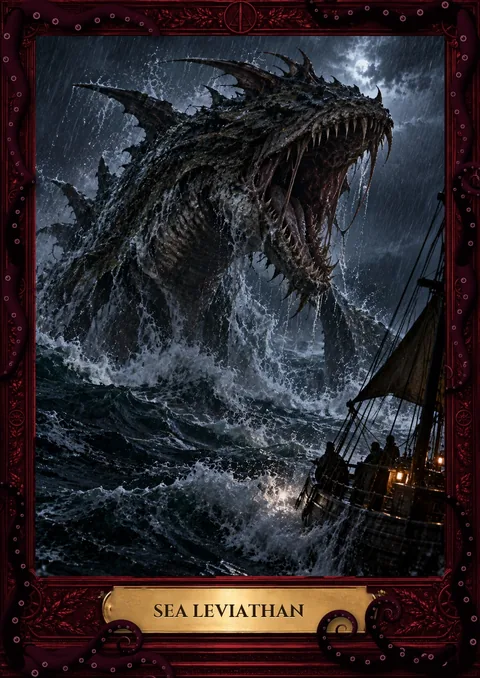
Sea Leviathan
Vast, finned and toothed, it rises alongside a ship on the long routes, higher than her mast. In the reports it is a great sea creature, for want of any better name.
The outer lanes and the far water, oftenest in storm or heavy weather
Seal Warden
A great armoured figure built into the threshold of a vault or a sealed room, with a lock in its chest and three slots for eyes. It lets pass what bears the right seal and stops what does not, and it does not stop gently.
Before vault doors, sealed laboratories and strong rooms; it stands in the threshold and does not leave it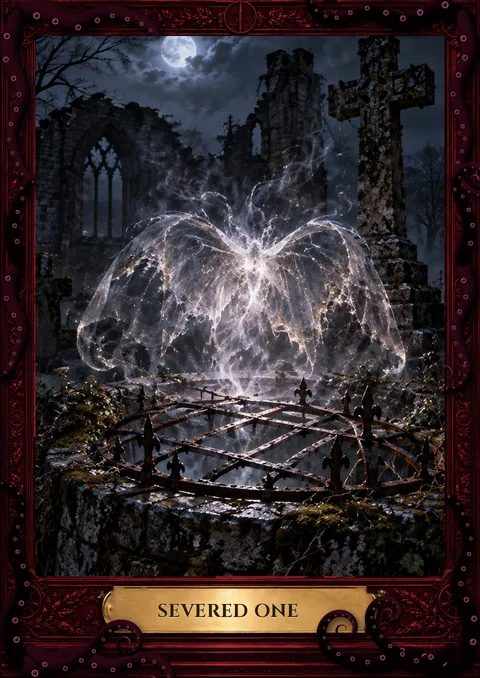
Severed One
Over a dry well capped with an iron grille and a blessing, a pale shape like smoke or a moth's wings circles, and cannot go in. It is the power of the well, cut off from its source. It is quiet now. The rolls say that what comes back is angrier.
Old wells and springs sealed under iron and a blessing, in churchyards and ruined priories
Skeleton
Bare bone in rotten harness, a sword still gripped: the old dead that will not lie quiet. The country knows them from the ordinary walking dead by one mark, which is that the bell does nothing to settle them.
On the steps and in the doorways of church ruins, and about old burial ground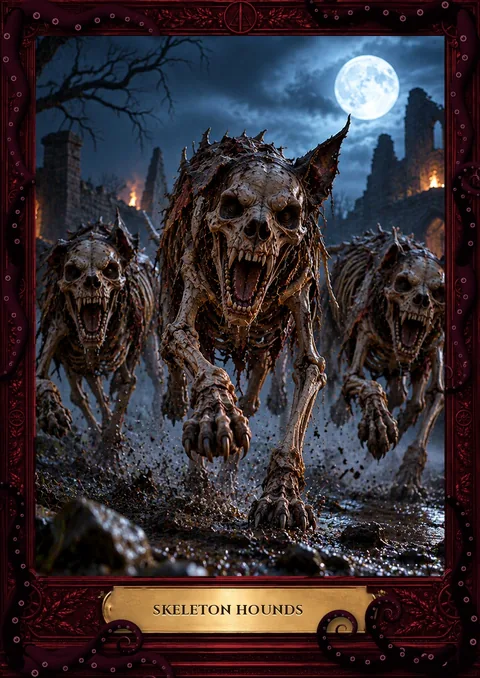
Skeleton Hounds
Hounds of bone and tatters, a pack that runs through ruins in the night and whose feet make no sound. Their handlers say it is the dogs who know of it first.
By night, in a pack, through ruins and across open ground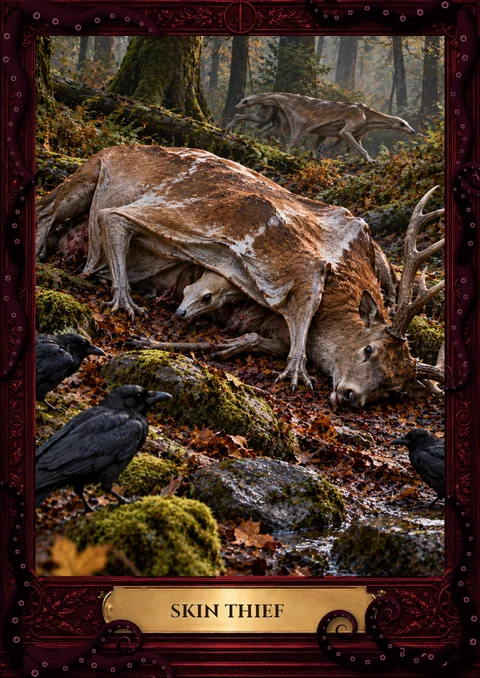
Skin Thief
It lies under the hide of a dead beast, a stag’s for choice, so that the crows will take the carcass for no more than a carcass: a pale, hairless scavenger, long and low-slung. The woodwards enter it first as poaching, which is precisely what it looks like.
The combes of the beech hangers, among the remains of what the wood has killed; told chiefly of those stretches of hanger that stand on nobody’s rotation
Sleeping Fell
Every winter the snow, cornice and ridges of one great fell lie in the shape of a curled, sleeping creature, one closed eye a hollow of blue ice. The upland says a great power sleeps under the hill, and that the one thing nobody should do is wake it.
A high fell of the northern march whose snow and ridges lie, every winter, in the shape of something asleep
Smoke Horror
Over drowned ground a shape of smoke and red fire reaches out with its limbs. Smoke does that, says the most part of the county; but the flash families do no fishing where it has been seen.
Over the coal country’s flashes, when the smoke of the smouldering tips settles low on the water
Sour Ford
A ford that was safe for centuries turns brown and foul, and out of the water heaves a mass of drowned branches, rot-coloured foam and dead reeds with a sick yellow-green light inside. It is the power of the ford, blighted, and its fury is a wound, not a hunger.
A ford gone bad below new drainage or works upstream, where the water has turned brown and the fish float
Spirit Stug
A great shining thing with eyes upon stalks, passing through a ruin while wolves attend it like hounds. In the country's telling it is the power of the ruin, and the wolves are its own.
A ruin by moonlight, with good grazing left untouched about it and wolves ranging over it
Spirit Wolf
On the rock above the pack stands a pale wolf that shines. The upland reckons it no beast but a power of the ridge, though the wolves follow where it goes.
Up on the rocky ridges of the upland, above the woods
Stair Sentinel
A guardian built into a staircase, carved as a gargoyle on the newel or a knight of metal on the landing. Dark, it is ornament. Lit, it closes the stair, and what is on the stair when it closes stays there.
Great staircases, landings and galleries of old houses, colleges and offices; it is built into the stair it guards
Stalkeye
It clings above the mouth of an adit, a yellow thing long in the limb, with eyes upon stalks and a round mouth set about with teeth, and it waits until a lamp passes under.
Old ground below: the adits that lead to it, and any place where a working has come through into older workings or a cavern
Starved Spring
Beside a new pump-house, in a spring basin choked with silt, stands a hart of thin light and dry reeds with its ribs showing, reaching for the last trickle. The spring's power is dying, and a dying power is the most dangerous kind there is.
Old springs and holy wells gone dry beside new pump-houses, mill leats and mine drainage
Still Shepherd
A village where nothing goes wrong: no quarrels, no drink, no noise. The raven on the roof, the dog in the yard and the innkeeper all turn their heads at the same moment, towards the same hill.
Old mines and sealed caverns, and the quiet villages above them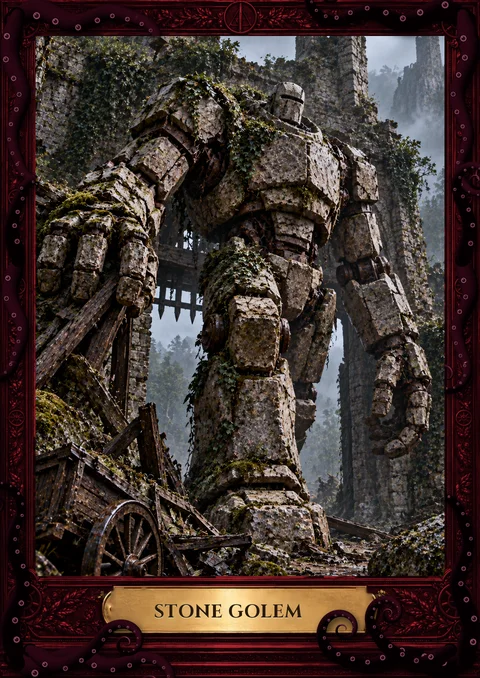
Stone Golem
Built of jointed stone blocks and colossal in size, it stands in a ruined fortification’s gate and holds it. Made it was, as all golems are; who made it the realm cannot say, nor what it was set to keep.
Some ruined fortification whose gateway still stands, an old keep, curtain wall or gatehouse round which the nearest village takes the long road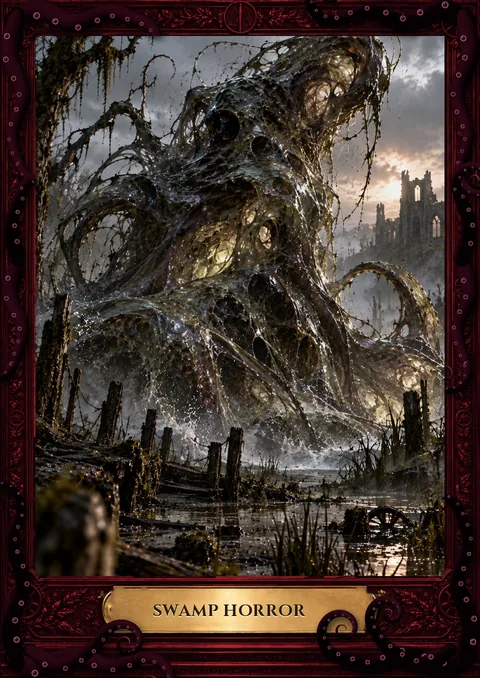
Swamp Horror
As tall as the dead trees it walks among, a moving heap of weed and root and feeler is said to keep the deep marsh that lies past the causeys. Of the several names the marsh has for it, none is ever spoken.
Out past the causeys at Oxford’s edge, in the deep marsh and the drowned water of the Cut
Swamp Lion
A great cat of the wet country, water-darkened and heavier in the shoulder than any hound, that takes boar and swine at the margin of the reed. The fen holds it a beast and answers it as a beast, that is, by cutting the reed.
In the reed and wet woodland that ring the Sarrum flashes and the march fens, wherever the reed has been let go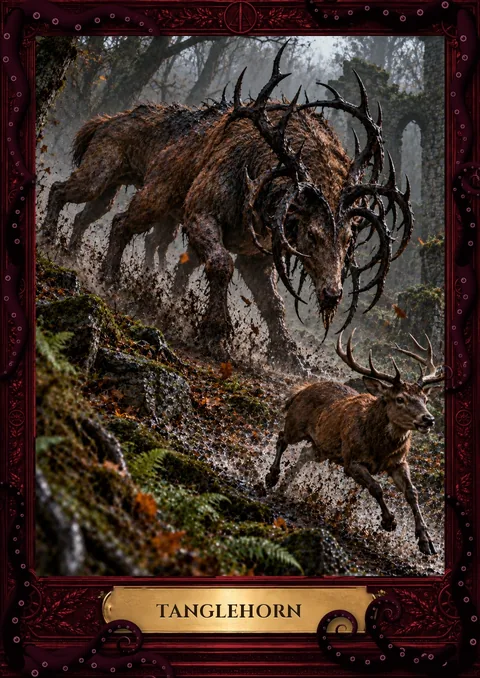
Tanglehorn
Running the deer down off the hill comes a heavy, shaggy beast with a wolf’s head and a rack of black antlers. It keeps, say the charcoal burners, the edge of ground that belongs to something else, and is not itself that something.
Along the edges of the no-cut belts, those bands of old wood that are never felled: on wooded hillsides and the deer walks of the wood
Tatterlimb
All limbs and trailing tendrils and hung with rags, it is seen crouched on the broken arches above the dales, quite still for as long as anyone watches. Morning always finds it gone elsewhere.
On the broken walls and ruined holdings of the ridges above the dales, as seen at dusk from below
The Forgotten Knight
At sundown, on the old roads, a dead knight in rusted mail and a ragged red surcoat goes walking towards a place that has passed out of all remembrance.
On old roads and on fallows nobody keeps, in open country as the sun goes down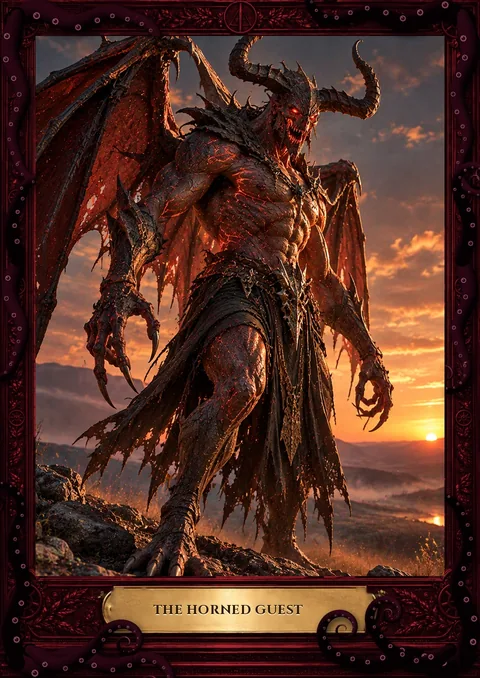
The Horned Guest
Horned, red as a forge and taller than a door: this is what the country sees when it pictures a demon, and the Horned Guest is the name it gives the picture. The doctrine holds that a demon is no matter of horns, and the country pictures horns all the same.
In the tales told of a few avoided ruins, and in sermons, chapel plays and road songs
The Skinless
At sunset something stands up on the open marsh and walks, upright, all red sinew and spines, the light showing through it. Nobody goes out to learn what it is.
Out on the open Bone Marshes, as watched from the rim roads when the sun is going down
The Star Below
Deep underground, above black water, hangs a thing of light and trailing limbs that no two witnesses describe the same. The pitmen named it for the first thing anyone sees: a light where there is no lamp.
Deep below, in the caverns that the lowest green-coal levels and iron shafts have broken into, and upon their waters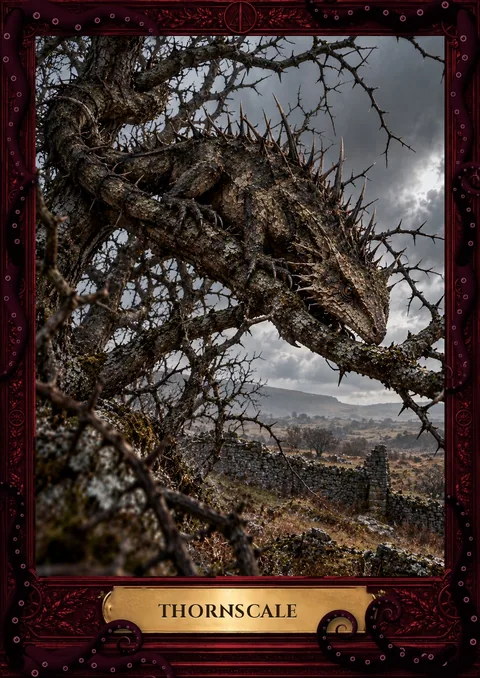
Thornscale
A lizard the size of a pony, its back grown with spines like blackthorn, that lies along the bare living thorns of a blighted piece so still it cannot be told from them. It takes what strays to the wall.
Inside the walled blighted pieces where the thorn stands bare and alive
Thrum
A plated thing as long as a tithe barn on forty legs, which lives in the chalk under a soured district. The grinding of its plates is heard for miles at night, and the country named it for the sound.
The swallow-holes and chalk galleries under a soured district
Torn Sail
Seen far off it is a torn black sail blown along a cliff. Closer, the sail is skin stretched on long finger-bones, and under it hangs a gaunt horned beast with hooked hind claws and a whip of a tail. The quarry chapel calls it a manticore; the quarrymen call it the Torn Sail.
Sea cliffs, deserted quarry faces and the broken tops of signal towers
Trusted Teacher
The best teacher anyone in the county ever had. The pupils read early, reckon brilliantly and remember everything, except, in time, their own families. Forty years on they come back and sit silently at the children's desks.
Small schools, tutors' rooms and lecture halls; and later, wherever its old pupils sit
Undead Bear
Rotted to the skull and red of eye, a bear that died and did not keep dead comes on regardless. What it is, the country disputes; what to do about it, the country does not.
In the wilder ground of the march, among ruins and at the wood's edge, under the moon
Vampire
A man or woman alive and under a curse, who does not age, who must feed on blood, and who in look is like anybody else. The realm says undead, has no lawful word for such a person whatever, and will hardly ever know one on sight.
Rented rooms and ordinary houses, the far side of a shop counter, the chairs at a recital; among neighbours who have known them for years
Vampire Oak
Dead deer lie at the foot of this immense oak, whose leaves are dark red and whose roots feed. The living deer stand about it and watch, and the foresters take their watching as the sign to keep away.
Deep in the old deer woods, where one great oak stands alone in a clearing that grows nothing else
Vault Hound
It comes up out of a burial vault into the crypt above: a grey, hairless thing the size of a mastiff, long in the jaw, with a mouthful of broken teeth. London calls it a hound since a hound is what it most resembles, and nobody there disputes the name.
Burial vaults and crypts, and the sealed crypt-lines beneath the old churches of London, where the city’s lower ways come close against the dead
Vein Worms
Where many dead once lay, a colony of pale, blind worms comes up through the sodden ground and feeds on what is there: each worm as thick as a wrist, its skin so thin that a branching of dark vessels shows through.
Rising through the turf in heavy rain, on old battlefields and wherever many dead lay too long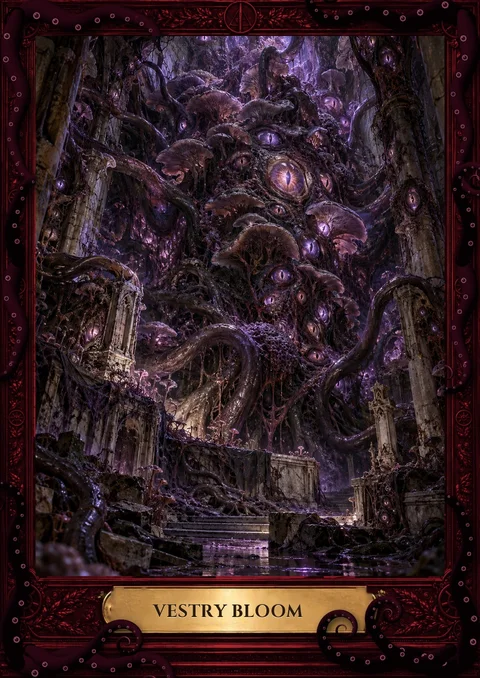
Vestry Bloom
A chapel that is always occupied, in a village where everyone is polite and nobody will let a traveller leave. What looks like damp on the walls has eyes.
Small chapels, shrines, schoolrooms and watch-houses in out-of-the-way places, rooted under the altar or in the crypt
Walking Thorn
Taller than a man, a ball of thorn and bramble goes about on legs of root, bearing off whatever it has snagged: fleece, rags and, in one account, the cross from a parish bound post. The march first knows it is there because a thorn is missing from where the book has it.
The bound lines and fallow ways of the upland parishes, and the becks between, which it wades in wet weather; told most where a bound has gone some years without a proper walking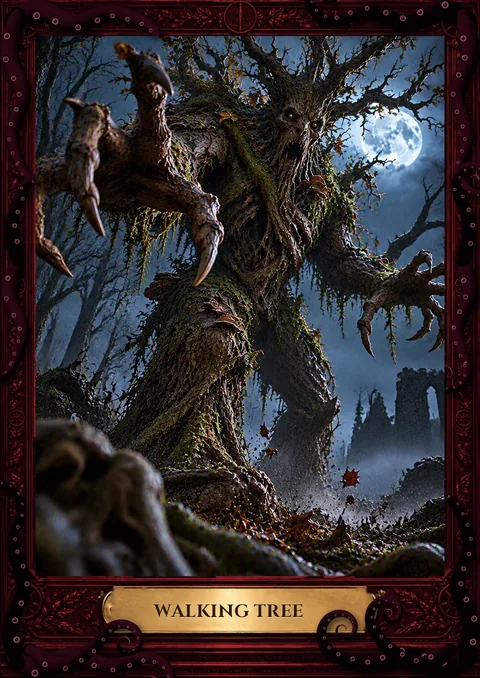
Walking Tree
Clawed branches for arms, a face in its bark, a giant’s shape: so it is told, walking the old uncut ground. In the charcoal burners’ account it is not what that ground is kept for, but what keeps it.
Old woods kept from the axe: the no-cut belts of Wychwood, and the hangers of the High South, kept more lightly
Werewolf
Of all the names the country has for its fear of the woods by night, the oldest is the wolf that walks upright. Wychwood’s hearths say it belongs to the wood.
Under the moon, in old woods and the ruins standing in them
Whisper Imp
An imp, pale and thin and enormous in the ear, that lives on the shut upper floor of an empty inn and calls down the stair in a voice it has stolen. The drovers met it long ago with a rule they still keep: where the mouth cannot be seen, the voice is not answered.
The shut upper floors of inns the road has left half empty, and drove inns fallen to ruin
Widow Horse
At dusk a gaunt black mare walks in among sound horses, and by morning they are lame. The county takes her first for a thief’s trick, and for something else only afterwards.
At dusk, in the county’s horse pastures and on its upland grazing
Widow Who Will Not Leave
A widow in black at the door of a cottage under a great yew, with frost on the window in the shape of leaves. Her family sold the land, her children have gone, and she will not leave. Her breath and the yew's mist are the same colour. She has tried to go, more than once.
A cottage under a great yew, on a holding her husband's family kept for three hundred years
Wire Wisp
A long, nearly clear thing that lives in relay rooms and signal cabinets and feeds on the current that passes along the copper. A message sent through a cabinet that harbours one arrives late, weak or wrong, and the clerk at the far end is blamed.
Relay rooms, signal cabinets and current stations; it lies along the conductors and feeds on what passes
Worm-headed Ghoul
Long and low and spined, with a head that opens into a knot of pale feeding tendrils. That the clearance men class it with the corpse eaters is owing to its being found where they are, and to nothing better.
Wet ground below and along the water: old channels, culverts and flood cells, and drowned ruins where old bones lie
Zombie
In grave clothes, a wooden cross yet at his neck, one of the dead who did not settle goes walking. More such are met in the march than in any district of its size, and the march will not have it that wickedness is the cause.
Open country towards dusk, upon the homeward road or by a gate that was his own in lifeNothing the country has seen answers to that description.
