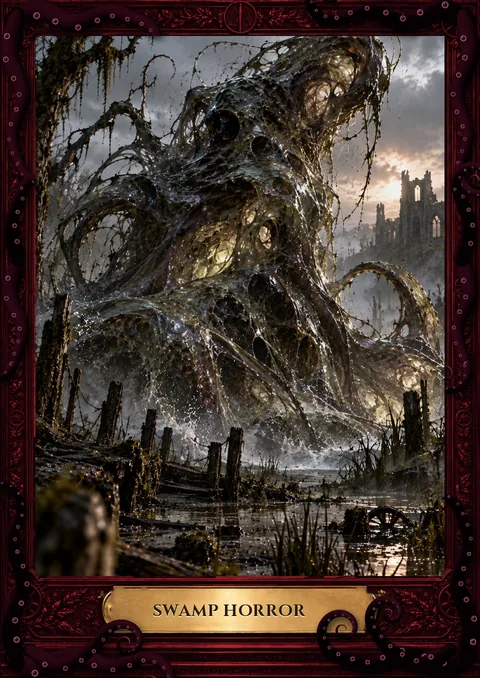
“Aske at Litel Mere and thou shalt be answered curteisly and tolde no thing. That is nat unkyndenesse. That is the mersshe.”
As the marsh tells it, courteously and not at all
A traveller who asks at Little Mere is answered with every courtesy and told nothing whatever, and the marsh would have him understand that no unkindness is meant by it. There is a day in the year that is kept, and a place that is kept. Somebody goes out to her, and it is not the priest of the chapel. To a stranger the village will confirm not one of these things; nor will it deny one.
The Witch is fed by four settlements, and in all that time not one of them has reported her. The name given oftenest is Mother Joan Reed; whether she is the same Witch the older stories speak of, or merely the latest of a line, the marsh does not discuss. The Concord of Saint Winnow, the order that treats with local powers and keeps the roll of their terms, has twice come to enter hers in it. It has twice been turned away, and politely.
The families who work the mere keep terms of their own. Nobody works it after dark, at any season, for any money. Nobody takes from three places in it, and a stranger will be shown the three without comment. Nobody goes onto the water on four days of the year, and they are not the four you would guess, nor the same four at White Reeds. The chapel has had four incumbents in forty years, and the marsh regards that as the city’s problem.
What is known
Of all the settlements behind the line in the Oxford Marsh, which is to say on the reclaimed and taxed side of the boundary between drained ground and open marsh, Little Mere is the largest: some four hundred people, perhaps, with a chapel, two inns, a reed market and a Reed Cross station kept there permanently. Long custom makes it the seat of the Witch of Little Mere, a standing local power with whom the households round about have their arrangements. She is a Lady in all but the name. The marsh does not use that name; it says Witch, without malice, and with a good deal of care. When a station reports something it cannot account for, the Reed Cross consults her, quietly. Nowhere else in the belt does there survive so clear an example of a settlement holding terms with a named power.
The mere itself has no fixed edge, four hundred acres in a wet year and two hundred in a dry, and cannot be owned in the way ground is owned. Nine households work it instead in a rotation that is unwritten and unbroken in living memory: eels, fowl, reed and leeches. The causey wardens know the families’ refusals, record none of them, and arrange their own business around them.