District · London
Commons
The Lower City is the old, low-lying part of London, also called the Commons, and the part of the capital where labour, cellars and tide stairs are concentrated. Common thought treats it as both working infrastructure and a moral warning, and people speak of what lies beneath it with the caution they give deep water. It was razed in large part by the Great Fire of 4487 and again scorched in 4556.
History and lore
The Commons, or Lower City, is the old low-lying body of London, laid over the buried city and under the raised platforms of Westminster. It grew from the river footholds of the reclamation, from Bridegate and Westminster Rise, through the Ash Scouring of 4041 and the hardening of the capital by pumps, bridges and yards between 4084 and 4116. Twice it has burned. In 4487 the first Great Fire, wind-driven, burned for fourteen days and razed wide stretches of it before demolition, pumps and exhaustion stopped it at the lower edge of the High City. The second, in 4556, broke out of Southbank and White Dock, from their varnish, oil and timber yards, and ran eight days through the river wards. Warehouse spacing hardened after the first, the law on lamps and volatile stores after the second.
Most Londoners live here. The Commons are docks and manufactories, terraces and alleys, parish houses and counting rooms, public houses and ferries, and they are not one slum but many climates packed close: one lane muddy, the next handsome. Lime Quay smells of chandlers and rope, Bellmarket of notices and cheap inns; the works stand in Boilerfields and Ironbank; Eastmere and Saint Olave's Ward keep their parishes; Holborn, Ludgate Hill, Blackfriars and Greywater each answer to their own bell. Around the pylons that carry the High City stand warm, cramped terraces, wash houses and pie shops, prized by the poor in winter for the heat that leaks from the steam mains. The district's rhythm is bread queues, market mornings, foundry whistles, school release and the weekly burden of rent and washing.
The Commons remember. Every August the Fourteen Fires open on the sixth: the bells ring, each ward hears its readings, and fire-watch sermons are preached, and the poorer wards recall evictions and warehouses saved while houses burned. Newgate Gaol stands here, and Bethlem House, and Saint Anne's Infirmary. The people speak of what lies beneath with the caution owed to deep water and old wells: porters of stairs that never lead to the same place twice, river men of culverts where in winter the tide sounds wrong. Children learn early which stair drowned whom and which baker gives credit only on the priest's word, and that knowledge is as much part of the district's fabric as its brick.
A visitor should learn the ward, the stair and the bell before anything else, and should expect to be judged by how he behaves on a crowded stair. Cheap inns gather at Bellmarket. Trouble goes to the ward beadle and the parish woman. Fire, fog and the river stairs after dark are the dangers that actually kill people here.
Where the volumes speak of it
- Book I › Chapter 8 — London and the Lower Thames: The Capital Lens › 8.4 Thresholds, undercity, and dependence
- Book I › Chapter 8 — London and the Lower Thames: The Capital Lens › 8.5 Labour, rumour, and the memory of fire
- Book I › Chapter 8 — London and the Lower Thames: The Capital Lens › 8.6 The city above and below
- Site › Chronicle of the Realm › The Great Fire
- Book II › Chapter 17 — Law, Archives, Hospitals, and the Keeping of the Dead › 17.8 Physicians, Surgeons, Apothecaries, and the Medical Market
- Book II › Chapter 22 — The Undercity: Old City, Gutters, Sewers, and Lawful Descent › 22.8 Regional Touched beneath the city
Powers seated here
Within Commons
Building
 Building Bethlem House London's most famous and most feared refuge for the mentally ill, standing in the Commons. It is something between a hospital, a spectacle and a prison, and is used for… Building Hall of Curiosities The Hall of Curiosities is an exhibition house in the London Commons, kept by John Nicholas Pike, which exhibits recovered finds after they have been rendered harmless.… Building Newgate Gaol Newgate Gaol is the great civic prison of the London Commons. It takes common criminals, the condemned, men wrecked by debt and anyone awaiting trial, sentence or… Building Saint Anne's Infirmary Saint Anne's Infirmary is a house in the Commons that combines nursing, alms, surgery and maternity work, drawing on women's labour, church charity and lower-city…
Church and shrine
District
District · 7 within Blackfriars A district of London on the river, home to the Noctuary Club, a society for dining and reading with a strong sense of the city's past. Edmund Vaun's painting Rain at… District · 1 within Boilerfields Boilerfields is a district of the London Commons where the heavier works stand, along with Ironbank. It is known by its shift whistles and the warmth of its steam mains.… District · 3 within Cheapside Cheapside is a district of the London Commons with shops along its front and old-clothes wards behind. Rag Fair lies behind it, and Blind Nan Rolt, the best-known ballad… District Eastmere Eastmere is an old ward of the London Commons, proud of its parish bells. Its bell team has a rival in Millbank's, which has staked sixty pounds at the Five Bells on… District · 2 within Greywater Greywater is a part of London where salvage men work, tied to the undercity and to chemical and technical trades. Hester Grayshott is the person to ask about Greywater… District · 4 within Holborn Holborn is a district of the London Commons, below the hill, where the common price scale holds. The Swan with Two Necks, the greatest coaching yard, stands there,… District · 2 within Saint Olave’s Ward Saint Olave's Ward is an old parish quarter of the London Commons, centred on Saint Olave's Graveyard, and it is counted parish country, like Eastmere beside it. Ward… Field and heath

House and estate
House and estate · 1 within Bell Court A lane in London so narrow that no corpse cart could turn in it, yet the Late Cart is heard there on wet nights, wheels and burial bell together. Funeral officers…  House and estate · 2 within Crowswell Court Crowswell Court is a court in the London Commons, known for modest debt and thin gentility, its people living a missed payment away from public embarrassment.…
Inn and venue

Market
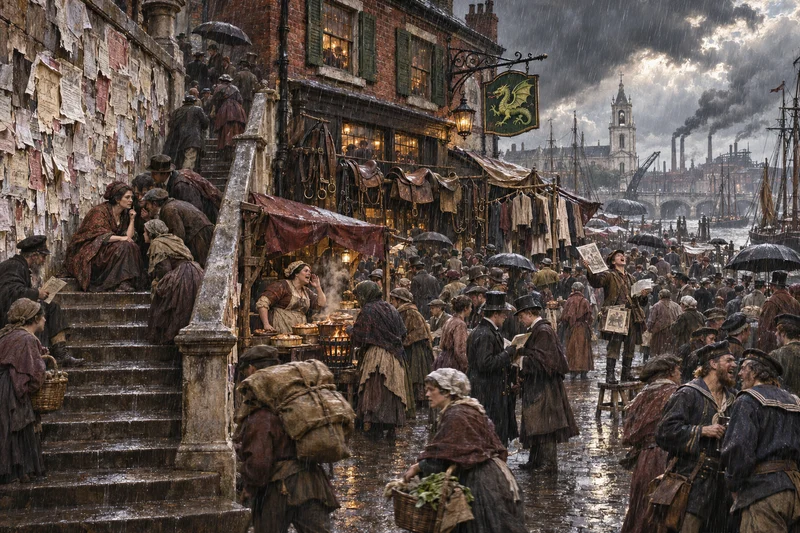 Market · 3 within Bellmarket Bellmarket is a part of the London Commons near the water, where public notices are posted and cheap inns gather, and where parish noise and open trade mix. It is named…
 Market · 2 within Cornhall Cornhall is the great market of the London Commons. Market Inspector Abel Dunmow sees that the weights are tested ahead of the opening bell. Cheesemongers such as Jethro…
Port and quay

Road and way
Street and square
Street and square Lantern Court A small spur in the Commons, off White Lily Passage, which makes less pretence than its neighbour. It is associated with discreet callers, cards, hired musicians and… 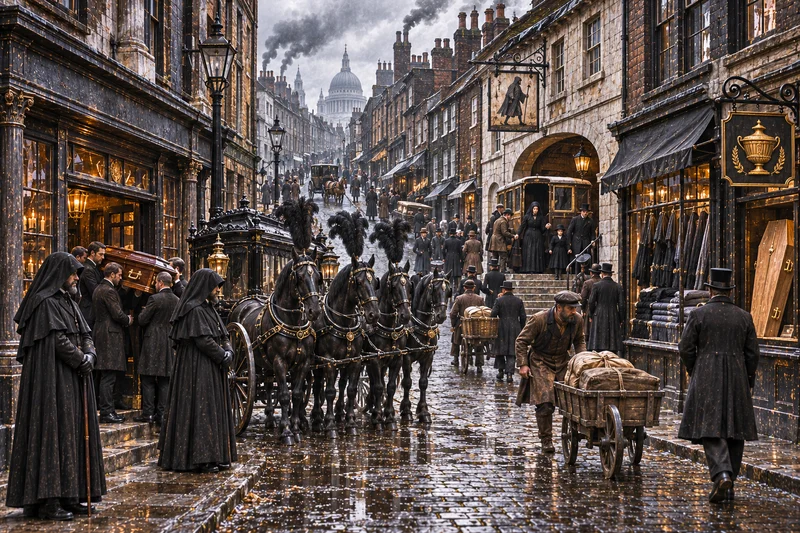 Street and square · 3 within Ludgate Hill Ludgate Hill is a London street of undertakers and mourning warehouses, of which Merriman's and Martha Gedge's are the best known. Its furnishing undertakers supply…
Works and stores

